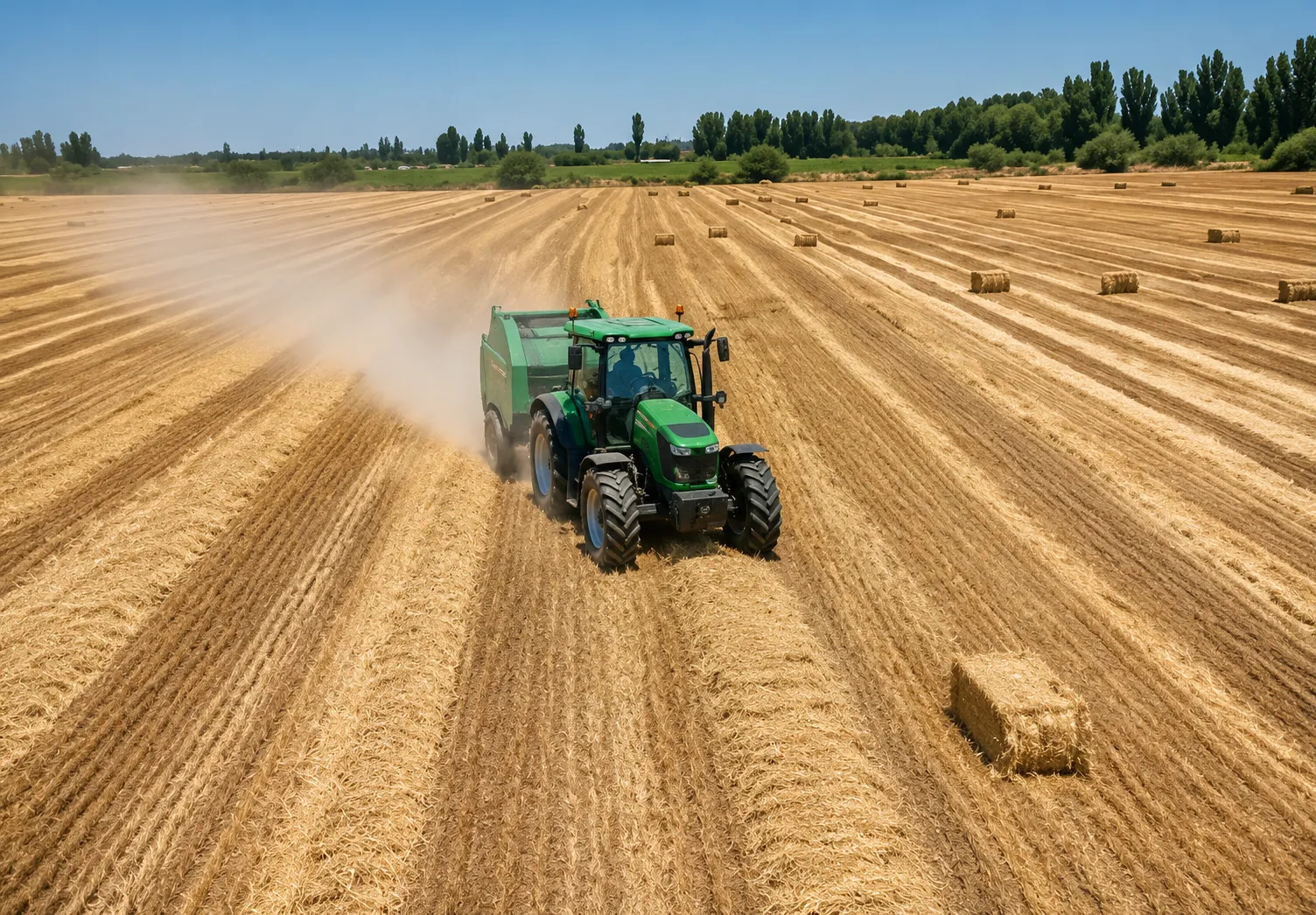
Across the arable plains of Lincolnshire, the stubble fields of Norfolk, and the mixed farms stretching through the Yorkshire Wolds, one machine consistently defines harvest efficiency: the square baler. Unlike round balers, which produce cylindrical rolls suited to silage and short-haul handling, square balers — sometimes called rectangular balers — compress crop material into dense, stackable blocks that dramatically simplify transport, storage, and downstream processing. For UK farmers managing straw, hay, and silage crops, and for industrial operators recycling cardboard, paper, and agricultural film, the engineering precision inside a modern square baler separates profitable operations from costly ones. This guide examines every layer of that engineering: the kinematic chain that drives the plunger, the metallurgy of the knotting bill hook, the tolerance standards applied in the knotting mechanism, and the performance figures that matter when comparing models for a specific UK application.
The square baler market in the United Kingdom has matured considerably over the past decade. Contractor operations running 10,000-bale seasons demand duty cycles and knotting reliability that simply were not available twenty years ago. At the same time, smaller mixed farms in Devon and Cumbria still need compact, tractor-mounted units that can handle variable crop conditions without specialist knowledge. Ever Power’s engineering team designs across this entire spectrum, combining high-volume manufacturing capacity with the flexibility to configure knotters, chamber dimensions, and PTO requirements to individual customer specifications.
How a Square Baler Works: The Full Kinematic Cycle
Stage 01 — Pickup & Auger Feed
The pickup reel — a row of spring-tine fingers rotating at 120–180 rpm — lifts cut material from the windrow and feeds it laterally toward the centre auger. The auger gathers the crop into a uniform slug and pushes it into the bale chamber throat. Tine pitch, finger profile, and reel diameter are engineered to match crop type: coarser tines for bulky straw, finer profiles for delicate hay that must not be shattered. The geometry of this first stage determines how evenly material enters the compression zone, which directly affects bale density consistency across the bale cross-section.
Stage 02 — Stuffer & Pre-Compression
A reciprocating stuffer fork pushes accumulated material from the feed channel into the main compression chamber in discrete charges. The timing of this fork relative to the plunger stroke is critical: the stuffer must retract completely before the plunger advances, or catastrophic mechanical damage results. A camshaft-actuated interlock mechanism enforces this timing with mechanical precision, independent of crop load. Pre-compression in the feed duct begins raising material bulk density from the loose windrow value (around 20–30 kg/m³ for dry straw) toward chamber entry density (typically 80–120 kg/m³), reducing the energy peak the plunger must overcome.
Stage 03 — Plunger Compression
The reciprocating plunger is the heart of the square baler. Driven through a heavy-duty crankshaft and connecting rod assembly, it advances into the bale chamber and compresses each new material charge against the growing bale column. Plunger force in large commercial models reaches 250–350 kN, sufficient to achieve final bale densities of 180–220 kg/m³ for straw and up to 400 kg/m³ for recycled paper and cardboard. The chamber cross-section is held to tight tolerances — typically ±1.5 mm — to ensure uniform pressure distribution across the bale face. Side panels and the top rail are often equipped with spring-loaded tension mechanisms that maintain consistent chamber pressure as bale length grows.
Stage 04 — Knotting & Ejection
When the bale reaches its preset length — detected via a star wheel or electronic sensor — the knotter mechanism activates. Twine from the supply spools is looped around the bale by the needle assembly, and the bill hook on the knotter head forms a secure overhand knot in approximately 0.4 seconds. High-speed camera analysis confirms the complete knot cycle must conclude before the plunger begins its next compression stroke. Double-knot versions, used in high-density or heavy-crop applications, form two parallel twine loops for added tensile security. The completed bale is ejected from the rear of the chamber by the pressure of the following material column, maintaining continuous throughput without operator intervention.
Core Material Science: What Your Square Baler Is Made From
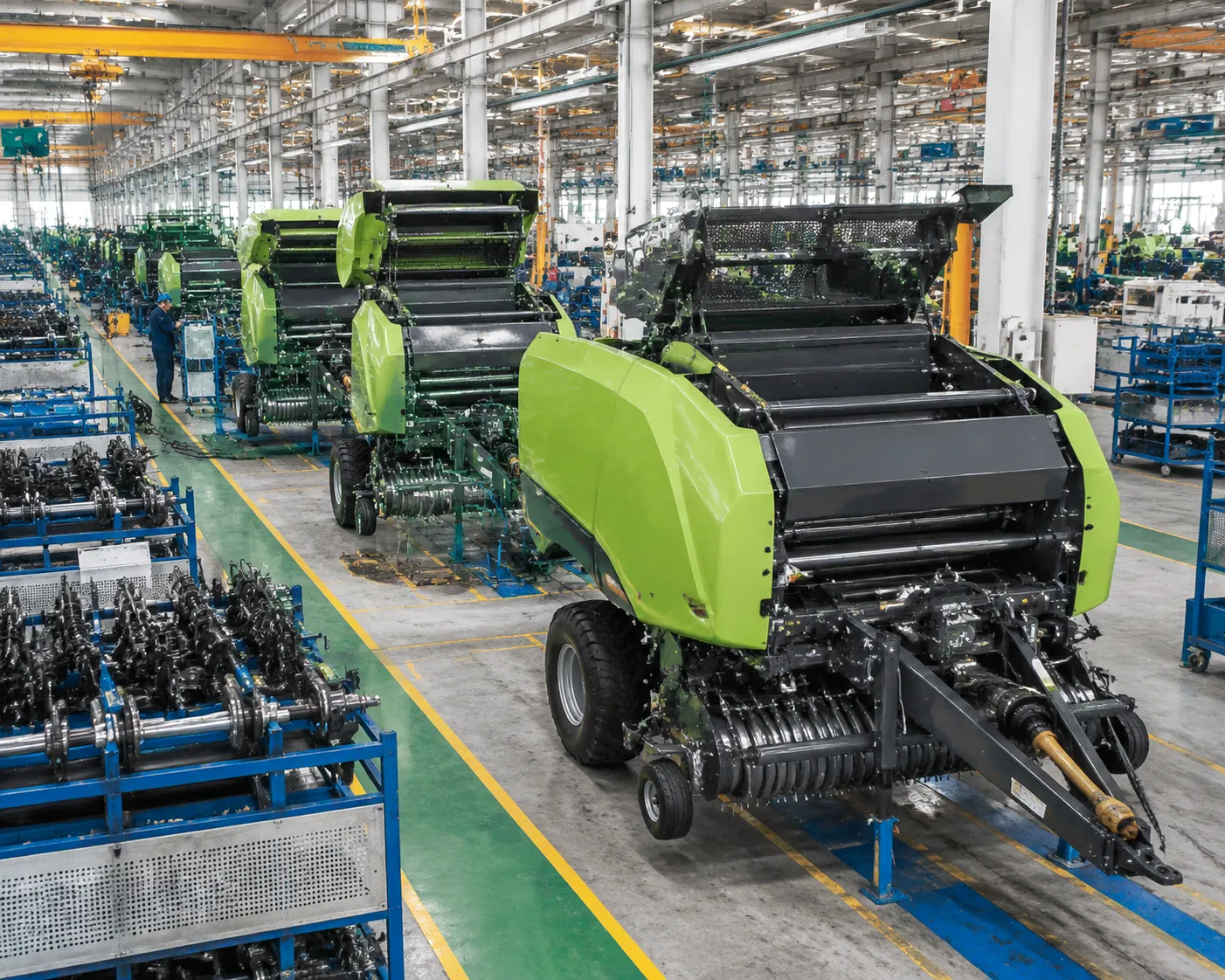
Material selection in a square baler is not simply an engineering decision — it is a reliability commitment. Every major structural and wear component operates in conditions that combine high cyclic stress, abrasive crop material, outdoor moisture exposure, and corrosive fertiliser residues. The choice of steel grade, surface treatment, and heat-treatment protocol for each component determines not just initial strength but the thousands-of-hours service life that separates a premium baler from a budget disappointment.
The main frame uses high-tensile structural steel — typically S355 or equivalent — hot-dip galvanised at 85 µm average coating thickness after welding. This combination provides a yield strength of at least 355 MPa to handle peak plunger reaction forces while resisting the salt-laden air common in coastal areas of Scotland and East Anglia. Weld quality follows EN ISO 5817 Class B standards throughout, with non-destructive testing applied at all primary load-path joints. The result is a frame that maintains dimensional stability across the full thermal range encountered during a UK harvest season — from dawn starts at 5°C to peak afternoon temperatures above 30°C in southern counties.
The plunger and chamber walls use Hardox 400 or equivalent wear-resistant steel where contact with compressed crop occurs. Hardox 400 offers a Brinell hardness of 370–430 HB, roughly three times the wear resistance of standard mild steel, meaning that surfaces subject to constant crop abrasion maintain their dimension far beyond a standard season. Bill hooks — the precision components that form knots — are case-hardened to 58–62 HRC at the working surface while retaining a tough, impact-resistant core below the hardened case. This dual-zone hardness profile prevents brittle fracture under the sudden shock loading each knot cycle imposes.
Product Advantages: Why Modern Square Balers Outperform Previous Generations
⚙
High-Density Compression
Modern large square balers achieve bale densities of 180–220 kg/m³ for straw — a 30–40% improvement over models from the 1990s. This directly reduces the number of trailer loads per harvest, with documented logistics savings of 25–35% on arable farms across East Yorkshire and the Lincolnshire Fens. Higher density also improves combustion efficiency when straw bales are supplied to district heating plants or industrial biomass boilers.
🔗
Precision Knotting Reliability
Knotting failure rates below 0.05% — meaning fewer than 5 missed knots in every 10,000 bale cycles — are achievable with precision-machined bill hooks and correctly tensioned twine from properly calibrated spools. Every missed knot creates a broken bale that spills material on the field and requires manual retrieval. On a 2,000-bale day typical of large UK contractor operations, even a 0.5% failure rate generates 10 broken bales, costing 20–30 minutes of downtime and crop loss.
📈
PTO Efficiency & Low Fuel Consumption
Advanced flywheel geometry smooths the cyclic load demand from the crankshaft, reducing peak PTO torque spikes by up to 35% compared with earlier designs. This means the tractor operates in a narrower throttle band, improving fuel economy by 8–14% per tonne of baled material. For UK contractor businesses running 500–700 tractor hours per baling season, the fuel saving alone can justify a machine upgrade within three to four seasons.
🔧
Serviceable, Modular Design
Knotter heads, pickup reels, and stuffer forks are engineered as bolt-on sub-assemblies that can be replaced in the field without specialist tooling. Bearing housings use standardised sizes matching common agricultural bearing ranges stocked by UK agricultural merchants, including those with depots in Sheffield, Peterborough, and Exeter. This approach means a breakdown mid-harvest does not necessarily halt an entire operation while waiting for proprietary parts to arrive from an importer.
☔
Variable Bale Length & Density Control
Adjustable chamber-gate tension systems allow operators to dial in target bale weight and density without stopping the machine. Sensors feed real-time compression force data to a simple display unit in the tractor cab. This capability matters significantly in the UK’s notoriously variable harvesting conditions, where a single field in Cambridgeshire can present dry, brittle straw in the morning and moisture-affected, heavy-stemmed material after afternoon cloud cover.
Technical & Performance Specifications
| Parameter | Standard Models | Heavy-Duty Models | Notes |
|---|---|---|---|
| Bale Cross-Section | 460 x 360 mm | 800 x 500 mm / 1200 x 700 mm | Tolerance ±1.5 mm |
| Bale Length (adjustable) | 400–1,000 mm | 600–2,400 mm | Star-wheel or electronic sensor |
| Plunger Force | 80–150 kN | 220–350 kN | Hydraulic overload protection |
| PTO Input Speed | 540 rpm | 540 / 1,000 rpm (selectable) | Shear-bolt or slip-clutch protection |
| Required PTO Power | 40–80 kW (55–110 hp) | 100–180 kW (135–245 hp) | Flywheel smooths torque spikes |
| Throughput Capacity | 8–18 t/h | 20–45 t/h | Crop-dependent; dry straw basis |
| Bale Density (straw) | 120–160 kg/m³ | 180–220 kg/m³ | Adjustable via gate tension |
| Knotting System | 2 knotters (twin twine) | 4–6 knotters | Bill hook hardness 58–62 HRC |
| Pickupbredde | 1,700–2,000 mm | 2,000–2,400 mm | Spring-tine or cam-controlled |
| Frame Steel Grade | S355 konstruktionsstål | S355 + Hardox 400 wear zones | Hot-dip galvanised, 85 µm avg. |
| Maskinens vægt | 1,800–3,200 kg | 5,500–12,000 kg | Configured to tractor hitch class |
| Twine Capacity | 4–6 balls per side | 8–12 balls per side | Polypropylene or sisal compatible |
Industrial Application Scenarios Across UK Agriculture and Industry
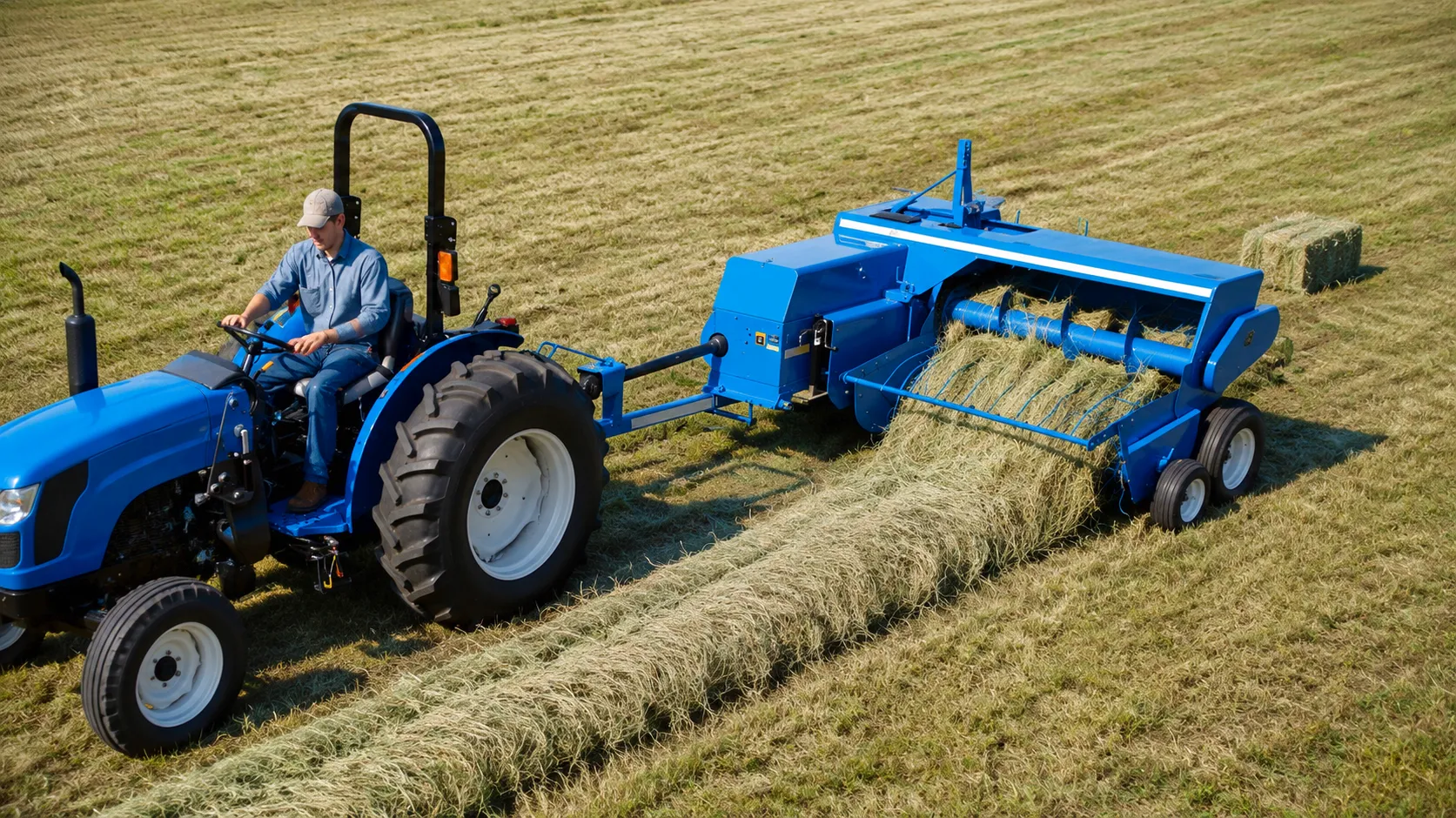
In UK cereal production, the square baler’s primary role remains straw collection from wheat, barley, and oilseed rape fields. The combinable crops sector, particularly concentrated in the east of England, generates millions of tonnes of straw annually, and dense square bales maximise the number of bales that fit on a standard agricultural lorry trailer within UK road weight limits. A 13.6-metre curtain-sided trailer can carry 88–100 large square bales at 200 kg each — approaching the 18-tonne gross trailer payload limit while leaving acceptable margin for trailer and tractor tare weight.
The UK biomass energy sector — anchored by processing plants in Yorkshire, Humberside, and the East Midlands — demands consistent bale dimensions and density for automated boiler feed systems. Square bales feed more reliably than round bales into conveyor and shredder systems because their flat faces stack predictably and their consistent density gives combustion engineers a reliable energy-content estimate per unit. Several dedicated energy straw operations based near Sheffield and Doncaster run entire logistics chains calibrated to specific bale weight targets, which requires baler settings to be verified and locked before seasonal work begins.
Beyond arable applications, square balers serve recycling operations in a growing number of UK industrial facilities. Cardboard and paper balers operating in distribution centres — including large logistics hubs around Birmingham’s NEC district and the Midlands motorway network — use stationary or semi-mobile square baling units to process OCC (old corrugated cardboard) streams. The dense, securely knotted bales meet the specification requirements of paper mills and export shippers at Teesport and Tilbury Docks, where container loading efficiency depends directly on bale geometry being within tight dimensional tolerances.
Hay & Haylage Production
Grass hay and haylage operations, particularly in the dairy-farming regions of Cheshire, Somerset, and Cumbria, rely on square balers for high-density bales that can be stored in covered sheds without specialist handling equipment. Precision knotting at high moisture contents — up to 25% in haylage applications — demands higher twine tension and more robust bill hook geometry than dry straw, driving demand for adjustable-tension knotter heads.
Industrial Hemp Processing
The expanding UK industrial hemp sector, with cultivation licenced under Home Office regulations and processing facilities established in Norfolk and Derbyshire, uses square balers to handle the long-fibre stalks left after rettig or decortication. Hemp stems are substantially denser and tougher than cereal straw, requiring reinforced chamber wear linings and stuffer fork tines rated for higher shear loads. Ever Power supplies custom configurations adapted for fibre crop applications upon specification review.
Agricultural Plastic Recycling
Sheeted polytunnel film, silage wrap, and irrigation pipe are increasingly collected and baled at UK farm level before collection by specialist recyclers. Baling agricultural plastics requires smooth chamber surfaces, slower plunger speeds, and modified gate tension to prevent tearing or uneven compaction. Several UK local authorities running farm-plastic collection schemes in Shropshire and Herefordshire specify baler settings as part of collection contracts.
Thatching Straw Supply
A niche but high-value segment of the UK straw market — thatching-grade long straw from heritage wheat varieties — requires specialised baling that preserves straw stem alignment and avoids breaking stems that reduce thatch quality. Low-pressure baling with a reduced plunger speed and wider-pitch stuffer tines is specified by thatching merchants who supply roofers working on historic properties across Suffolk, Essex, and the Cotswolds.
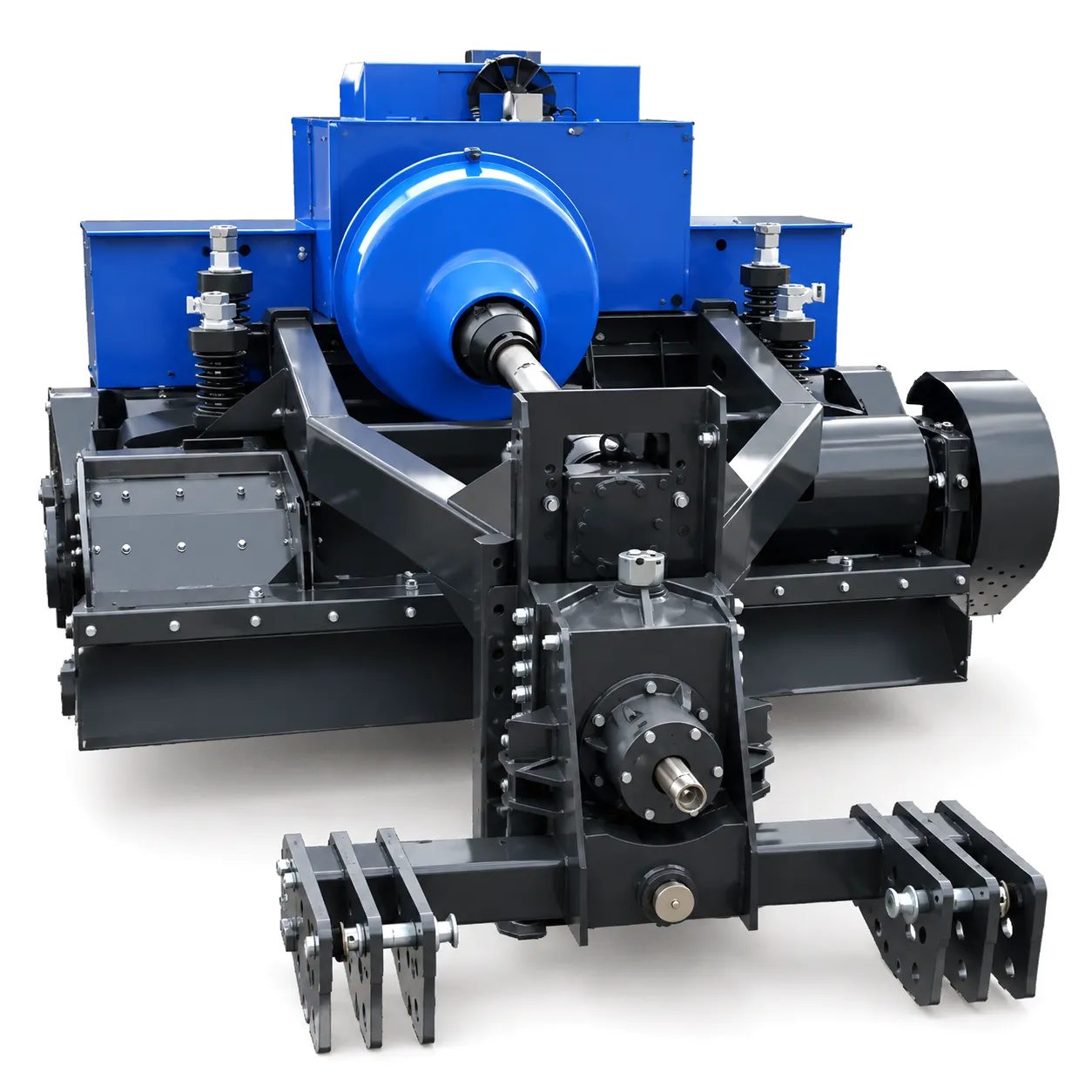
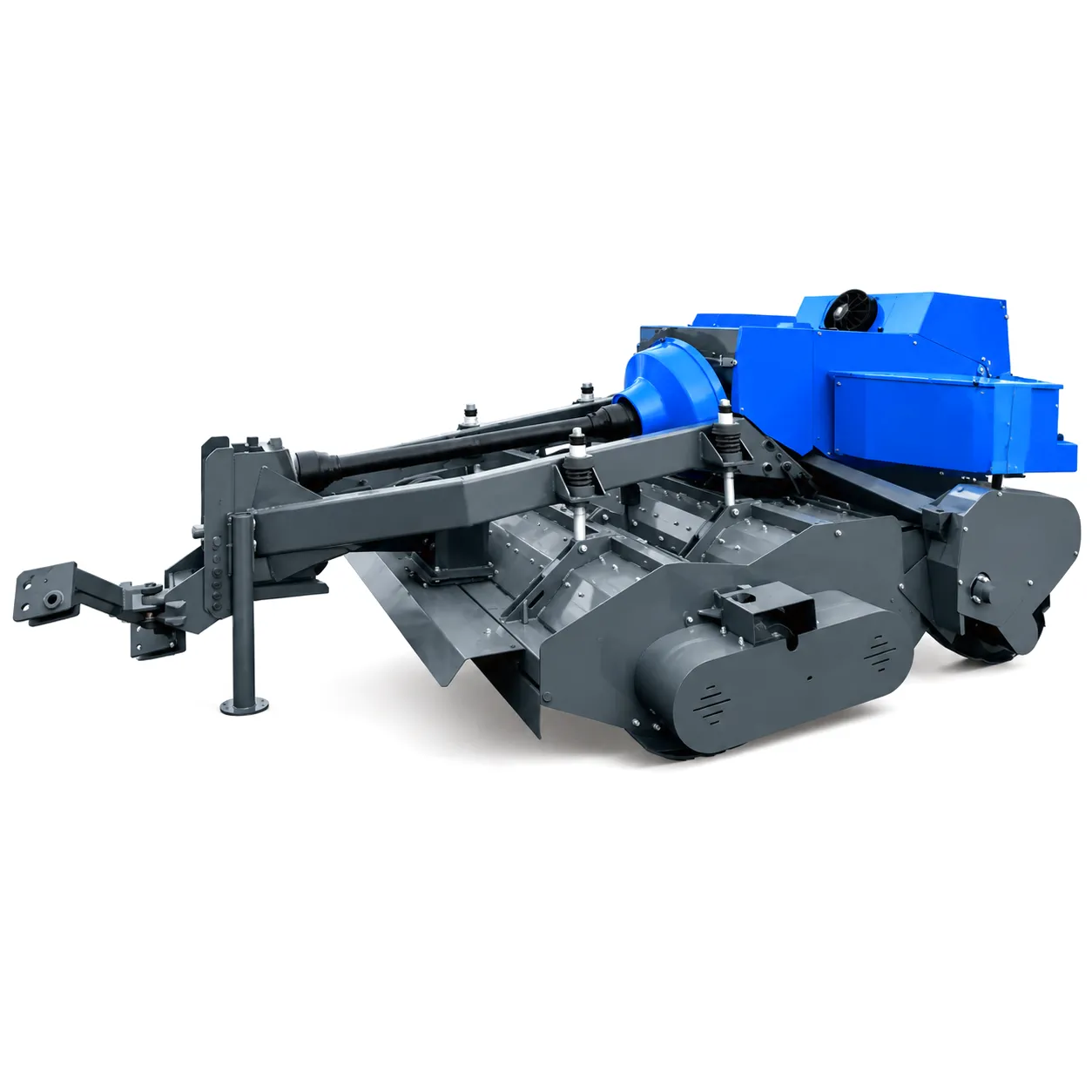
Featured Square Baler Products from Ever Power
Model 01
9YF-2200/1900/1700 firkantballepresser
The 9YF series is Ever Power’s core tractor-mounted square baler range, available in three pickup widths — 1,700 mm, 1,900 mm, and 2,200 mm — to match field conditions from compact paddocks to open arable plains. This model operates on a 540 rpm PTO input, making it compatible with the wide range of mid-sized tractors commonly used across UK family farms and contractor fleets. The chamber produces square bales in the 460 x 360 mm cross-section format that remains the industry standard for trailer stacking and storage racking. Robust S355 frame construction, adjustable gate tension, and a field-serviceable twin-knotter assembly make this an ideal choice for operators seeking reliable throughput without excessive mechanical complexity.
Model 02 — Double-Chamber
9YFS-2.2 Dobbeltkammer firkantballepresser
The 9YFS-2.2 Double-Chamber model represents a step-change in throughput capability. By integrating two parallel bale chambers fed from the same pickup and stuffer assembly, this unit can produce bales from two material streams simultaneously — a configuration particularly valued in large-scale UK contractor operations where field time is the limiting constraint. The dual-chamber design also offers an operational resilience advantage: if one chamber requires clearing due to a slug blockage, the other continues producing while the operator addresses the issue. High-capacity twine magazines, reinforced main frame joints rated for the increased reaction loads of dual-chamber compression, and an enlarged flywheel assembly combine to make this model suitable for the most demanding 2,000+ bale-per-day seasons in the UK’s major arable counties.
Ever Power Manufacturing: Custom Engineering for Demanding Operations
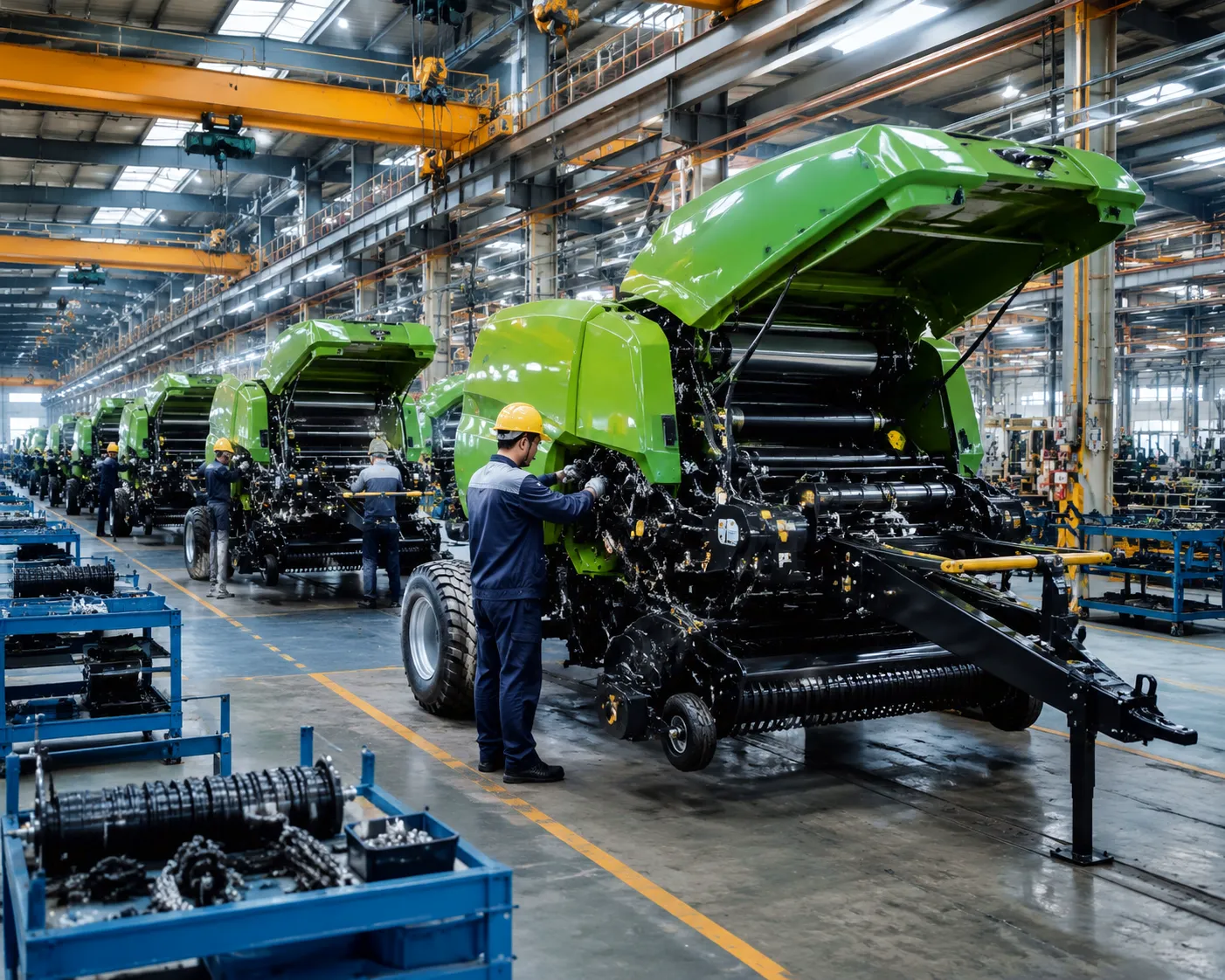
Ever Power’s manufacturing facility operates across 48,000 square metres of production floor space, housing CNC machining centres, robotic welding stations, heat treatment furnaces, and dedicated assembly lines for agricultural equipment. The company’s quality management system is certified to ISO 9001:2015, with product-specific validation protocols for all load-bearing components in the baling line. Dimensional inspection of critical components — crankshafts, bill hooks, plunger guide rails — uses coordinate measuring machines (CMM) with ±0.01 mm resolution, ensuring that every unit shipped meets the same geometric standards as the validated prototype.
Customisation capabilities are a genuine differentiator for Ever Power. Unlike distributors reselling fixed-specification imported machines, Ever Power’s engineering team can modify chamber cross-section dimensions, pickup width, PTO shaft configuration, and knotting system arrangement at the production stage. UK buyers operating in specialist sectors — thatching straw, industrial hemp, agricultural film — submit technical specification sheets that Ever Power’s engineers review against manufacturing constraints before issuing a formal feasibility assessment. Custom configurations typically require a minimum order quantity of 3–5 units, with standard lead times of 45–60 days from order confirmation to factory-ready inspection.
The supply chain supporting Ever Power’s baler production covers steel procurement from certified domestic mills, proprietary bearing supply from SKF and FAG approved sources, and twine-system components sourced from established knotter manufacturers. This supply chain depth means that material shortages affecting the broader agricultural equipment market typically do not translate into delivery delays for Ever Power orders. The company maintains a safety stock of critical long-lead components — crankshafts, bill hooks, and plunger assemblies — equivalent to 90 days of production volume, providing genuine schedule reliability that UK importers have documented in post-delivery reviews.
Custom Square Baler Specifications Available
Speak with Ever Power’s engineering team about chamber dimensions, PTO configuration, and knotter arrangement for your specific crop or industrial application.
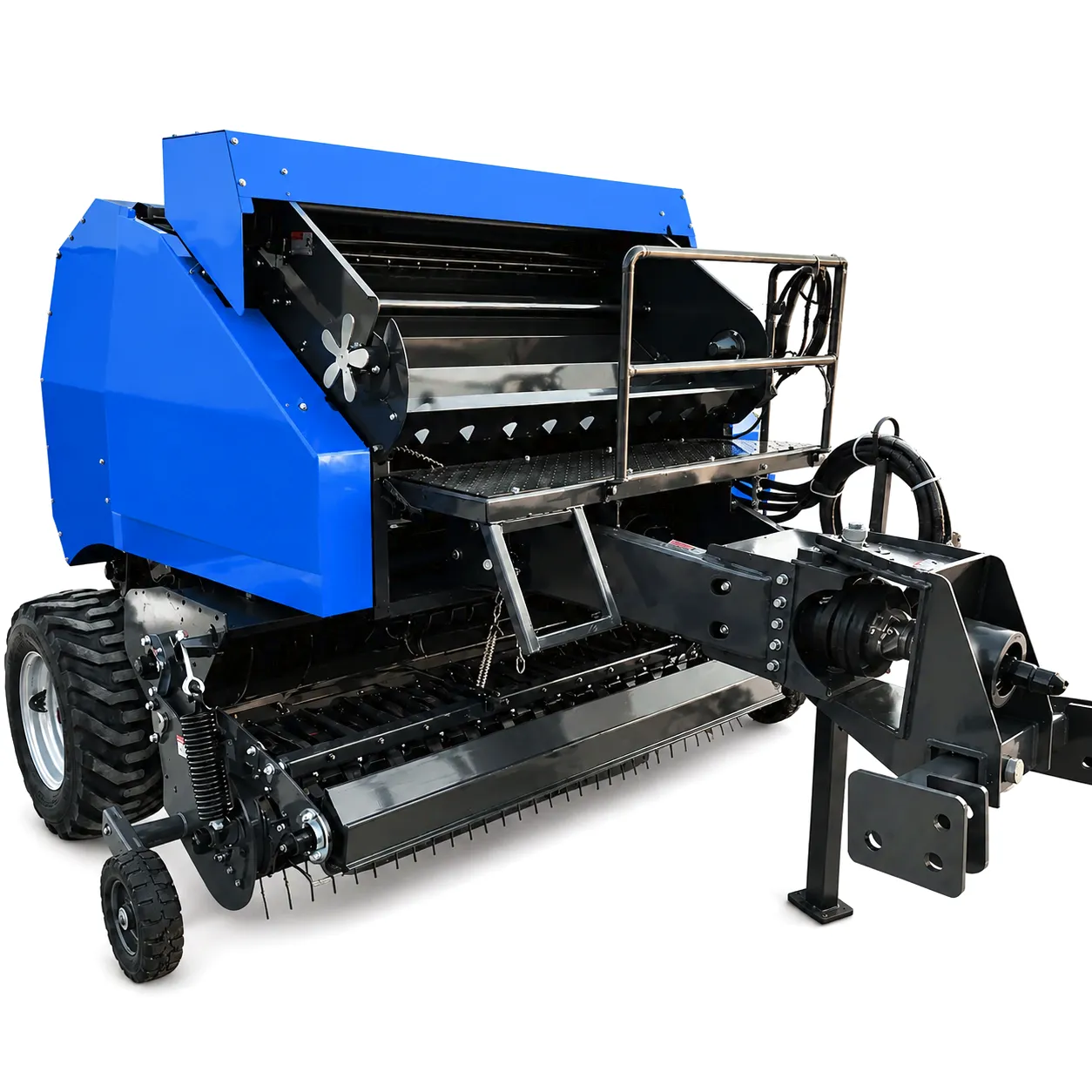
Ever Power 9YQ-1950 Round Baler — complementing the square baler range for silage and mixed-farm operations.
Customer Success: Straw Logistics Operation, Lincolnshire
Fenland Agricultural Contracting Ltd, based near Spalding in South Lincolnshire, runs one of the region’s larger arable contracting operations. The business provides straw clearance and baling services to approximately 35 farm customers across an area stretching from Boston to Holbeach, covering combined cereal cropping of around 4,200 hectares per season. Managing Director James Whitfield had operated a fleet of European-branded large square balers for eight years and was facing a machine replacement decision ahead of the 2024 harvest season.
The key requirement was a machine capable of delivering 180–200 kg/m³ bale density consistently across variable straw conditions — from the brittle, low-moisture straw typical of eastern Lincolnshire’s lighter soils in a dry July, to the tougher, higher-moisture material from heavier clay land further west after thunderstorm activity. The operation’s energy straw supply contract with a biomass processor near Sleaford had strict minimum density requirements, and knotter reliability was non-negotiable: the contracting business charged per bale, and broken bales that required retrieval and re-baling added unrecoverable time cost.
Following a technical specification review and factory inspection visit, the business commissioned two 9YFS-2.2 Double-Chamber Square Balers from Ever Power, configured with 2,200 mm pickup, six-knotter arrays, and a reinforced plunger assembly rated for 300 kN peak force. Ever Power’s engineering team modified the chamber gate tension system to allow finer in-cab adjustment than the standard model, directly addressing Whitfield’s requirement for density consistency across variable crop conditions. The machines were shipped to the UK and collected by the customer’s own low-loader from a designated UK freight point, with pre-delivery inspection documentation reviewed and accepted by the customer’s mechanic prior to departure.
Across the 2024 harvest season, the two machines completed 87,000 bales combined — averaging 43,500 bales per machine, well within the rated duty cycle. Average bale density achieved was 196 kg/m³ across all crop types, meeting the biomass processor’s specification on every consignment. Knotter failure rate over the season was recorded at 0.03% — three missed knots per 10,000 — below the pre-purchase specification target of 0.05%. The operation’s total diesel consumption per tonne of baled material fell 11% compared with the previous season’s figures from the replaced machines, reflecting the flywheel-smoothed PTO loading. Whitfield described the outcome as straightforwardly positive and confirmed a further order for two additional units for the 2025 season.
★★★★★
“We ran 43,000 bales through the 9YFS-2.2 last harvest. The double-chamber setup saved us at least two days of field time versus a single machine. Density was consistently 195–200 kg/m³, which kept our biomass contract specification met without any disputes. Ever Power’s pre-delivery documentation was thorough, and the custom gate tension adjustment they built in has made a real difference on variable Lincolnshire straw.”
James Whitfield, Fenland Agricultural Contracting Ltd — Spalding, Lincolnshire
★★★★★
“What impressed me most about working with Ever Power was the willingness to accommodate a non-standard pickup width request. We run on particularly wide windrow swaths in North Yorkshire and needed a 2,200 mm pickup. They confirmed the modification was achievable in the standard manufacturing run, not as a costly bespoke option. The machine has worked reliably since delivery and the knotting system has given us zero problems through a full hay and straw season.”
Robert Gill, Hambleton Farm Services — Thirsk, North Yorkshire
★★★★★
“We use the 9YF-1900 for our cardboard baling operation at the distribution centre outside Birmingham. The machine runs six days a week on OCC streams, and the bale geometry has been consistently within the 460 x 360 mm specification that our paper mill contract requires. Ever Power provided detailed technical data sheets before purchase, which was important for our internal procurement sign-off process. Parts availability through the UK importer has been faster than we expected.”
Martin Shaw, Operations Manager — West Midlands Recycling Group, Solihull
Frequently Asked Questions About Square Balers in the UK
Ever Power — Industrial Baling Technology | B2B Enquiries: [email protected] redigeret af gzl
Content produced for the UK agricultural and industrial markets. Technical specifications subject to model configuration — contact Ever Power for confirmed data on your application.