Square Balers: Engineering Principles, Performance Parameters & Industrial Applications Across UK Agriculture and Manufacturing
A technical guide for procurement engineers, farm managers, and B2B buyers evaluating high-density square baling equipment for straw, silage, biomass, and waste processing operations.
Response within 24 hours · Tailored specifications · UK shipping available
Working Principle: How a Square Baler Converts Loose Crop into Dense Rectangular Blocks
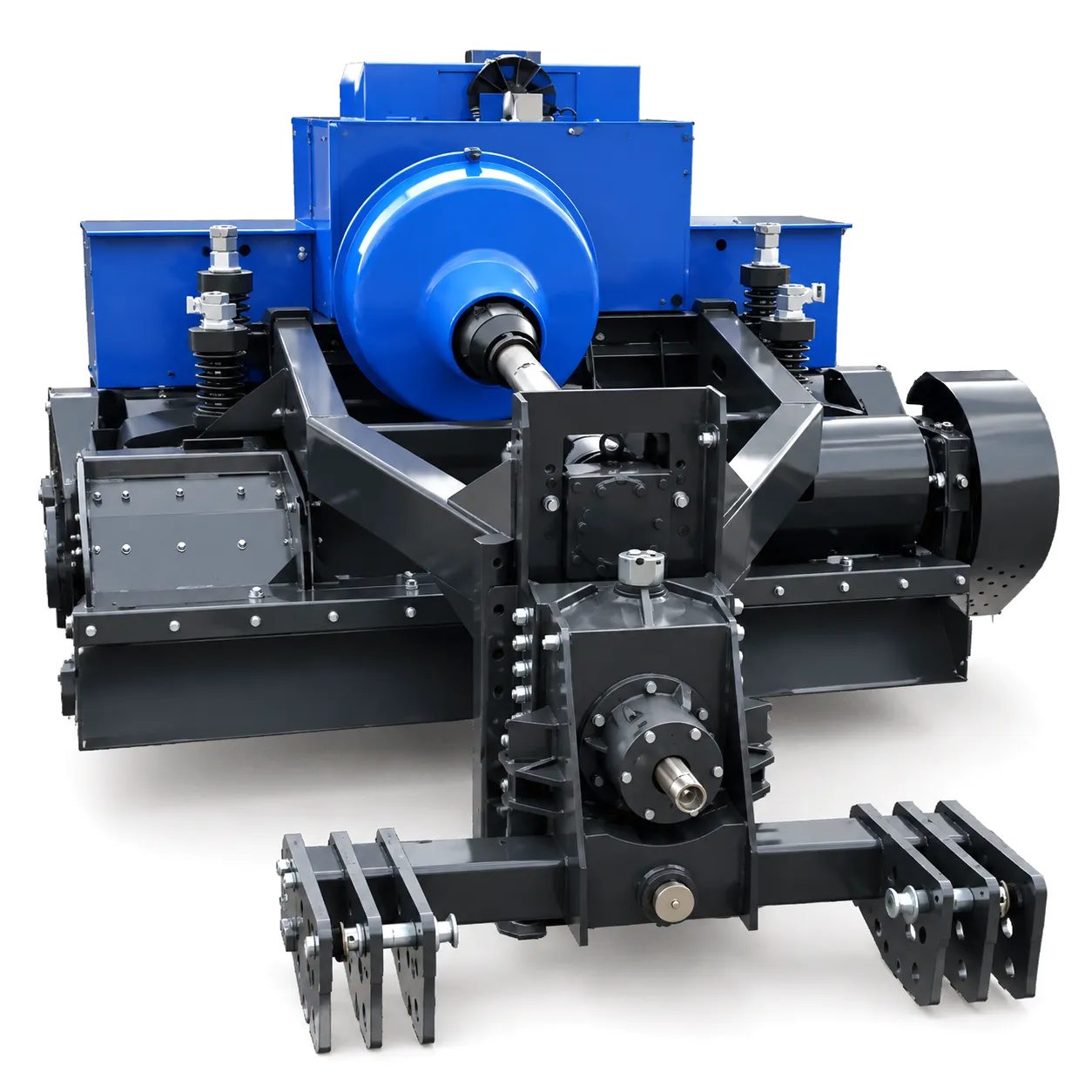
The square baler operates on a reciprocating plunger principle that is mechanically elegant in its simplicity yet requires tight tolerance engineering to deliver consistent bale density at high throughput rates. Power is drawn from a tractor’s power take-off shaft, typically running at 540 RPM or 1,000 RPM, and transferred through a gearbox to a crankshaft assembly. That crankshaft drives a plunger — a large, flat-faced compression block — back and forth inside a rectangular bale chamber. As the plunger retracts, a feed mechanism called the stuffer or packer pushes a measured charge of crop material from the pickup table into the chamber. The plunger then advances, compressing that charge against the previously formed material ahead of it. This cycle repeats continuously, with each stroke adding another compressed slice to the forming bale.
Bale length is measured by a metering star wheel that rotates as the bale is pushed forward through the chamber. Once the bale reaches the programmed length, a knotting mechanism is triggered. In a conventional twine-knotting system, needles carry strands of twine through the bale from bottom to top, where a knotted tie them to previously placed strands from the previous cycle. Two knots per bale width is the standard configuration for small square balers; large square balers typically use four or six twine strands to maintain integrity under higher compression pressures.
Net-wrap systems, increasingly common on large square balers, replace twine for outer wrapping, reducing the risk of individual string failure and improving bale stability during transport. The compression pressure itself is generated hydraulically in large balers, allowing operators to adjust density through electronic controls linked to pressure sensors in the bale chamber. The resulting bale is ejected from the rear of the chamber onto a chute and drops onto the field or onto a following trailer.
Core Technical Advantages of Modern Square Baling Systems
Consistent High-Density Output
Hydraulically controlled chamber pressure allows operators to maintain bale density within a narrow tolerance band regardless of crop moisture content or feed rate fluctuations. This consistency is critical for downstream storage, where variations in bale weight affect stack stability and loading calculations. Uniform density also simplifies biomass contracts where payment per tonne makes underweight bales a direct revenue loss.
Rectangular Profile for Transport Efficiency
The rectangular cross-section of square bales maximises packing efficiency in lorries, trailers, and shipping containers. In the UK agricultural haulage sector, where trailer payload regulations are strictly enforced, the ability to stack bales without void space between them translates directly into fewer transport movements and lower fuel cost per tonne delivered. A standard 1.2 m x 0.9 m large square bale format is optimised for palletisation and container shipping across European export routes.
High Throughput Capacity
Contemporary large square balers operate at plunger rates of 38–52 strokes per minute and can process between 25 and 60 tonnes of dry matter per hour depending on crop type and field conditions. For large UK cereal operations where harvest windows are compressed into days rather than weeks by the unpredictable British weather, maximum throughput capacity is not a luxury feature but a risk management tool. Minimising the number of hours spent in the field per harvest reduces exposure to weather-related crop losses.
Reduced Labour Dependency
Automated knotting, hydraulic density adjustment, and electronic monitoring reduce the skilled operator time required per tonne of bale output compared to manual or semi-automated systems. With UK agricultural labour costs continuing to rise and seasonal worker availability becoming increasingly constrained since 2021, machines that deliver high output with a single operator represent a meaningful long-term cost advantage for both owner-operators and contracting businesses.
Material Versatility
A well-configured square baler can process wheat and barley straw, oat straw, hay, haylage, maize stover, miscanthus, hemp, and short-rotation coppice material within a single season without major reconfiguration. This versatility supports diversified farm income streams and makes contract baling businesses viable across multiple crop types and multiple client farms within a reasonable operating radius.
Serviceability and Spare Parts Availability
Purpose-engineered component standardisation across machine ranges allows parts to be sourced rapidly during the harvest season when machine downtime is most costly. Ever Power designs its square baler component library to minimise unique part counts, so that a farm with multiple machines in different size classes can hold a reduced spare parts inventory while still covering the critical wear items across its entire fleet — a practical consideration that machinery dealerships and large arable operations consistently rank highly in procurement decisions.
Technical Performance Parameters — Square Baler Reference Table
The table below provides representative technical specifications across the small square, medium square, and large square baler categories commonly deployed in UK agricultural and industrial applications. Values reflect typical production-model configurations; custom specifications are available from Ever Power for high-cycle industrial deployments.
| Parameter | Small Square Baler | Medium Square Baler | Large Square Baler |
|---|---|---|---|
| Bale Cross-Section (W × H) | 360 × 460 mm | 600 × 700 mm | 1200 × 900 mm |
| Bale Length Range | 300–1300 mm | 400–2400 mm | 600–2700 mm |
| Bale Weight (Wheat Straw) | 8–20 kg | 80–180 kg | 250–600 kg |
| Stempelslagfrekvens | 80–100 strokes/min | 55–75 strokes/min | 38–52 strokes/min |
| PTO Input Speed | 540 RPM | 540 / 1000 RPM | 1000 RPM |
| Required Tractor Power | 35–55 kW | 70–110 kW | 130–220 kW |
| Pickupbredde | 1.65–1.80 m | 1.90–2.10 m | 2.00–2.30 m |
| Maximum Baling Capacity | 8–15 t/h | 18–30 t/h | 35–60 t/h |
| Knyttersystem | Twine (2 strands) | Twine (2–4 strands) | Twine / Net-wrap |
| Chamber Material | S355 steel, 8 mm | S355 steel, 10 mm | S420 steel, 12 mm |
| Plunger Hardness (Wear Face) | 55–58 HRC | 58–60 HRC | 60–62 HRC |
| Machine Width (Transport) | 1.80–2.10 m | 2.40–2.55 m | 2.55–3.00 m |
| Maskinens vægt | 900–1,400 kg | 3,200–5,500 kg | 8,500–15,000 kg |
Industrial and Agricultural Application Scenarios for Square Balers in the UK
Application Scenario 2: Biomass and Energy Crop Baling for Renewable Energy Supply Chains
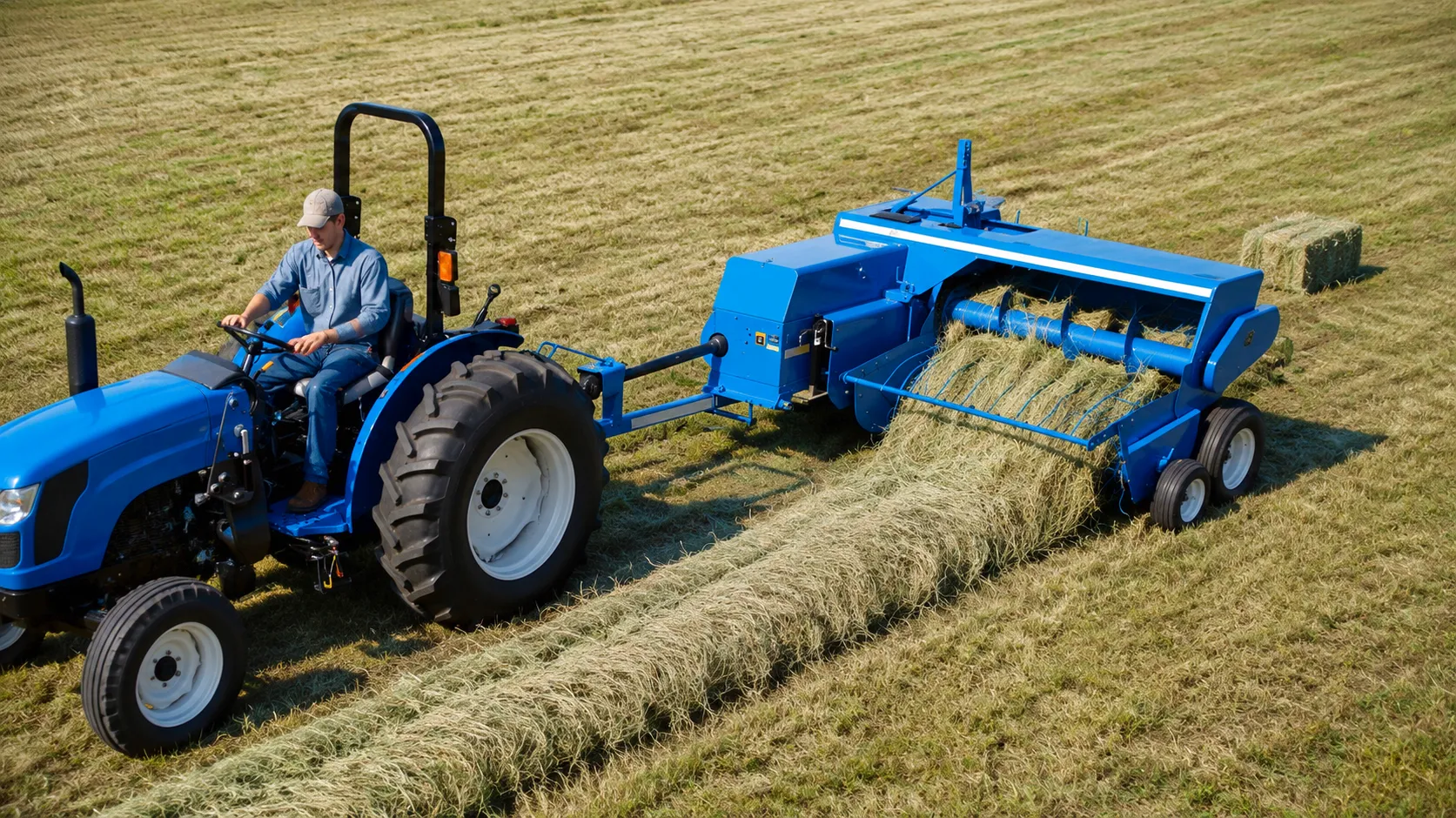
The UK’s renewable energy sector has created substantial demand for baled biomass in the form of miscanthus grass, short-rotation willow coppice, and reed canary grass. Power stations and district heating schemes operating under UK Bioenergy Strategy guidelines require bulk biomass in a densified, weatherproof form that can be stored and transported efficiently. Large square balers configured with high-density chamber pressure settings — typically operating at 180–220 bar hydraulic pressure — produce bales that meet the dry matter density thresholds required for boiler feed systems. In the West Midlands and Yorkshire, where biomass supply contracts for combined heat and power plants have become a significant element of farm diversification strategies, square balers are often operated by specialist agricultural contractors working exclusively on biomass collection across multiple estate sites per season.
Application Scenario 3: Industrial Waste and Recycled Fibre Baling in Manufacturing Regions
Beyond the agricultural sector, the compression mechanism of the square baler is directly applicable to industrial waste management. Facilities handling cardboard, paper, non-woven textiles, and baled agricultural plastics — materials increasingly regulated under UK Resource and Waste Strategy targets — use stationary or semi-mobile baling presses that operate on identical plunger compression principles. In Sheffield and Birmingham, where manufacturing industries generate substantial volumes of cardboard and industrial fibre waste, baling equipment allows materials to be compacted for cost-effective disposal or recycled fibre sale. The same high-density, rectangular output that makes a square baler efficient for straw marketing makes it equally applicable in a waste processing context, with minor chamber modifications to handle the different material densities involved.
Application Scenario 4: Equestrian and Livestock Bedding Markets Across Scotland and Northern England
The Scottish Borders, Northumberland, and the Yorkshire Dales maintain significant equestrian and livestock operations that require consistent, high-quality bedding straw year-round. The equestrian market places particular demands on bale quality: straw must be dust-free or low-dust, bales must be uniform in size for stable storage, and the binding must remain secure through repeated handling. Small square balers producing bales in the 360 mm × 460 mm format are the preferred tool for this market, as the bale size is compatible with manual handling within stable environments and the bale weight — typically 14–20 kg — falls within single-person handling guidance under UK manual handling regulations. Producers targeting equestrian supply chains often specify tighter bale length tolerances and reduced chamber dust levels, both of which can be addressed through machine configuration choices at the point of procurement.
Application Scenario 5: Export Hay and Forage Baling for International Markets via UK Ports
UK-grown timothy hay, ryegrass hay, and haylage have established export markets in the Middle East, Japan, and South Korea, where domestic forage production is limited by land availability. The shipping logistics for these markets demand bales with very tight dimensional consistency — container stuffing is calculated precisely to maximise cubic metre utilisation — and high dry matter density to minimise shipping cost per unit of feed energy. Large square balers operating at maximum compression settings produce bales that can be unitised on pallets and shipped in standard 20-foot or 40-foot containers from ports including Grimsby, Hull, and Tilbury. For exporters targeting these premium forage markets, the capital investment in high-specification baling equipment is recovered through the price premium achievable for consistent, export-grade product.
Ever Power Square Baler Product Range
Two core products engineered for high-throughput baling operations across cereal, biomass, and forage applications.
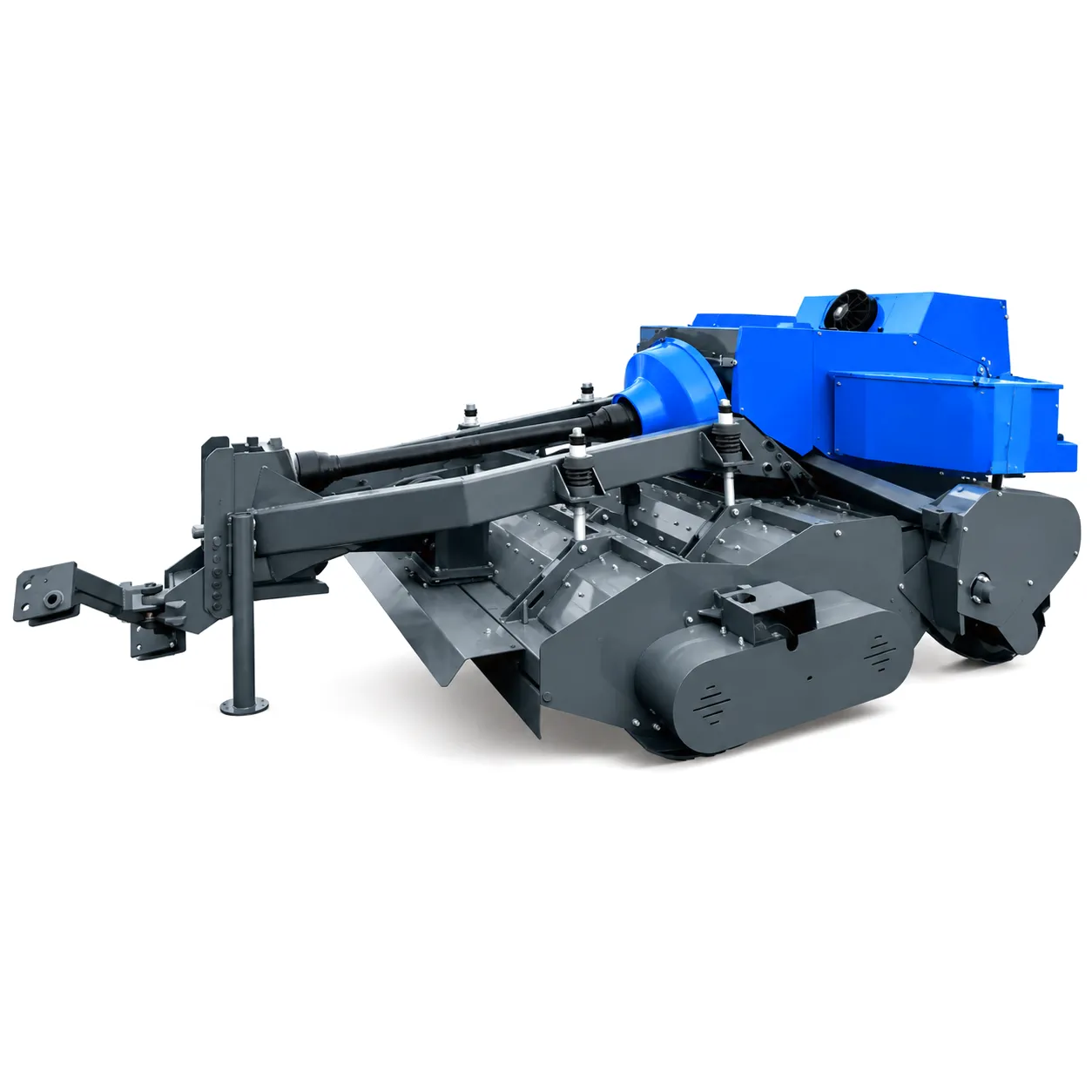
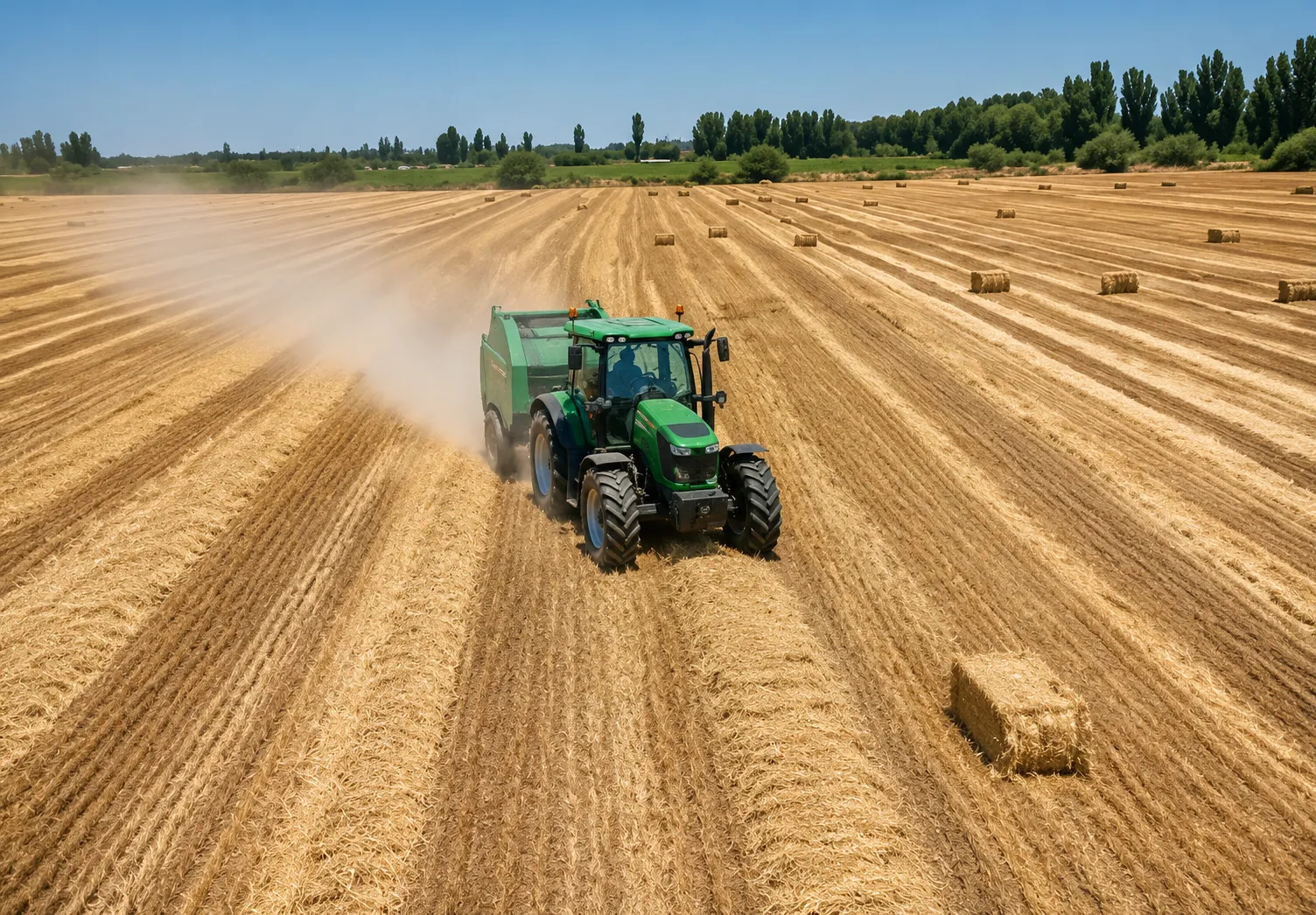
Large Square Baler
9YF-2200/1900/1700 firkantballepresser
A heavy-duty large square baler available in three working width configurations (2200 mm, 1900 mm, 1700 mm), designed for high-volume cereal straw and biomass baling operations. Features hydraulic density control, high-capacity pickup drum, and robust forged crankshaft for sustained high-throughput performance. Suitable for operations requiring 250–600 kg bales at throughputs up to 60 t/h. Proven in commercial arable and contract baling operations across the UK and Europe.
Double-Chamber
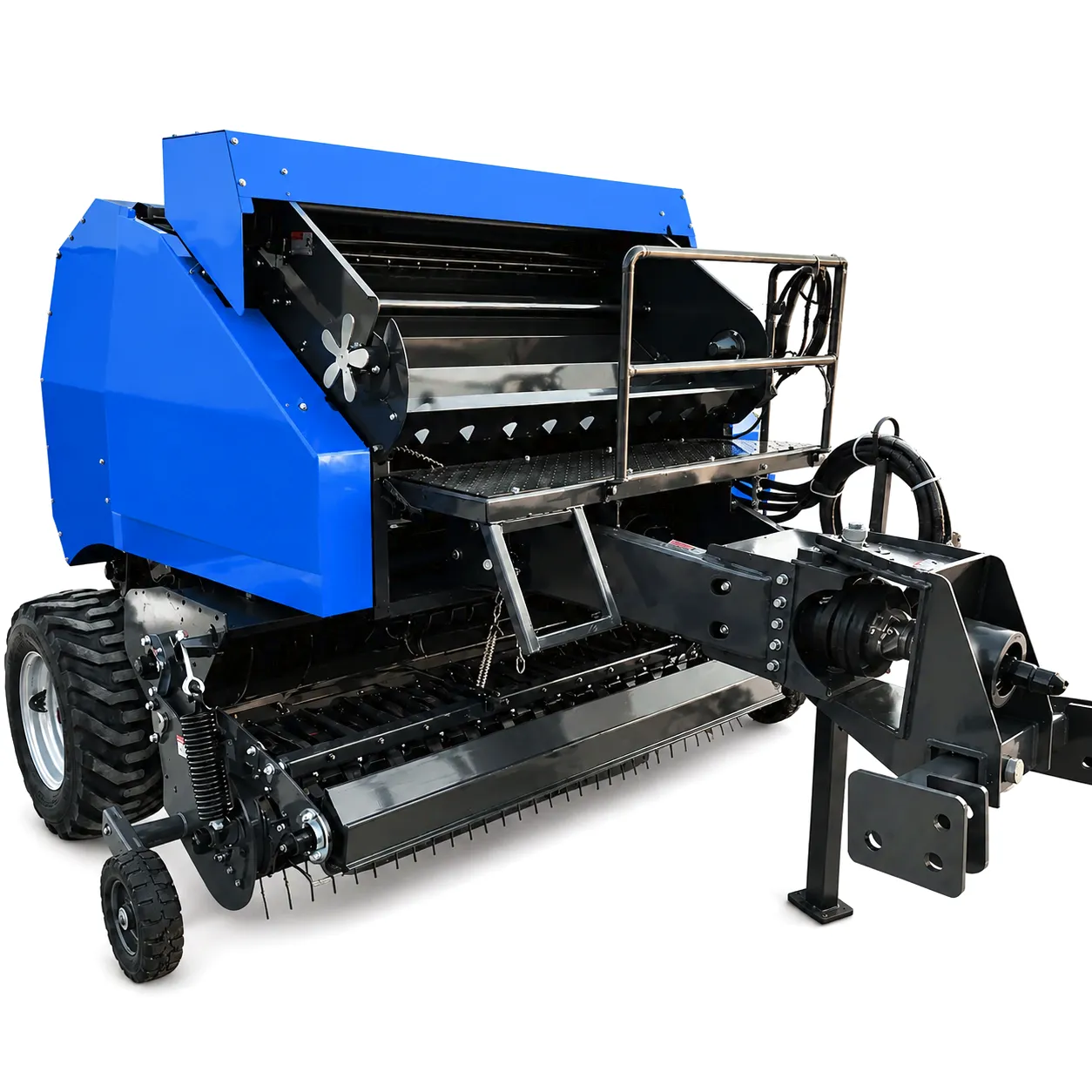
9YFS-2.2 Dobbeltkammer firkantballepresser
The 9YFS-2.2 features an innovative dual-chamber design that processes two bale sizes simultaneously or sequentially in a single pass, dramatically increasing operational throughput for mixed bale-size markets. Particularly well suited to operations supplying both equestrian small-square product and large-square export hay within the same crop season. Built to the same forged steel and case-hardened component standard as the single-chamber range, with independent density control for each chamber.
Frequently Asked Questions About Square Balers in the UK
How much does a large square baler cost to buy from a UK supplier and what should I budget for total first-year running costs?
▼
A new large square baler from a competitive B2B supplier typically ranges from £80,000 to £250,000 depending on specification, chamber size, knotter count, and electronic control complexity. First-year running costs — covering twine or net wrap consumables, knotter service parts, pickup tine replacement, and gearbox oil changes — typically add 3–6% of purchase price. Requesting an itemised quote that covers the machine, a recommended spare parts pack for the first harvest season, and any commissioning support is standard practice for UK agricultural machinery procurement. Contact Ever Power at [email protected] for a specific price on your required configuration.
Which square baler specification is most suitable for biomass energy crop baling operations in Yorkshire and the East Midlands?
▼
For miscanthus, short-rotation willow coppice, or reed canary grass baling in Yorkshire and East Midlands biomass supply chains, the recommended specification is a large square baler in the 2200 mm working width class with hydraulic chamber pressure rated to at least 180 bar, a high-capacity feed rotor rather than a simple stuffer fork, and a pickup drum with tine pitch suitable for long-stemmed material. The Ever Power 9YF-2200 is configured specifically for these requirements and includes options for custom pickup tine spacing on request. Throughput targets for biomass contracts should be discussed at specification stage to ensure the machine configuration matches the harvest window available.
Where can I find a reliable square baler supplier in the UK who offers custom specifications and can deliver spare parts quickly during harvest?
▼
Ever Power supplies square balers directly to B2B buyers across the UK including arable farming businesses in Lincolnshire, agricultural contractors in Yorkshire, biomass operators in the Midlands, and equestrian supply businesses in Scotland. We maintain stock of critical wear components for rapid despatch during harvest season, and our engineering team handles custom specification requests from initial enquiry through to machine commissioning. The most effective first step is to send your operational requirements — crop type, target throughput, bale size, tractor horsepower — to [email protected] and request a preliminary specification and price.
What tractor horsepower do I need to run a large square baler effectively on a UK arable farm producing wheat and barley straw?
▼
For a large square baler in the 1200 mm × 900 mm bale size class, producing bales at densities appropriate for commercial straw trading, a tractor delivering 130–180 kW (175–240 hp) at the PTO is the typical requirement under UK cereal straw conditions. In dense yields above 4 t/ha, or when baling at maximum density settings for export markets, having a tractor at the upper end of this range ensures the machine is never power-limited during high-crop-density periods. Tractor suitability should be confirmed with your machine supplier before purchase, as PTO shaft compatibility and hydraulic supply capacity also affect machine performance.
How does the double-chamber square baler design work and when does it make commercial sense for a UK agricultural contracting business to specify one?
▼
A double-chamber square baler maintains two independent bale-forming chambers fed from the same pickup and pre-compression rotor. The two chambers can be set to different lengths or different density targets, effectively producing two distinct bale products in a single pass. For UK contracting businesses that serve both equestrian small-square markets and large-square commercial straw buyers within the same geography, this eliminates the need to operate two separate machines across a harvesting day. The Ever Power 9YFS-2.2 is designed for exactly this operational model, with independent hydraulic density control for each chamber. The commercial case is strongest where the premium achievable in the small-square equestrian market — typically £5–£12 per bale above bulk straw price — justifies the additional capital cost over a single-chamber machine of equivalent total throughput.
Who are the most experienced square baler manufacturers supplying to the UK market and what sets Ever Power apart from catalogue-only suppliers?
▼
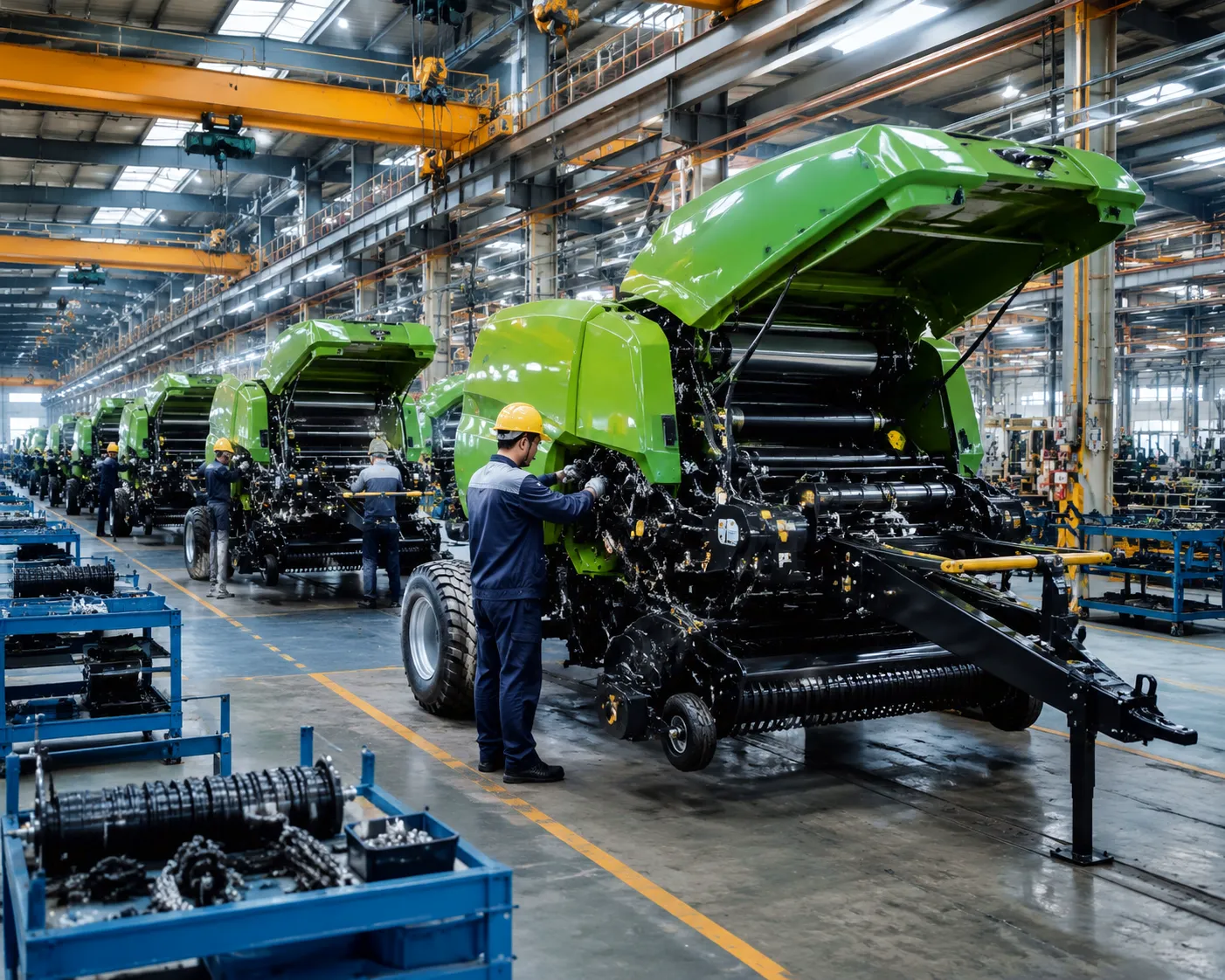
The UK agricultural machinery market includes both established European brands available through dealership networks and direct B2B suppliers from specialist manufacturers. Ever Power operates in the direct B2B category, providing a combination of engineering customisation capability, transparent pricing, and responsive technical support that dealership-model suppliers cannot consistently match. Our manufacturing facilities produce machines to customer-specified parameters — not catalogue options — with documented quality records on each production batch. For buyers who have specific operational requirements that don’t fit standard configurations, Ever Power’s direct engineering model provides a structural advantage over suppliers whose only customisation route is the standard factory option list.
Ready to Specify Your Square Baler?
Send your operational requirements to the Ever Power sales team. We’ll review your crop type, throughput targets, tractor specification, and downstream market requirements and come back with a preliminary machine configuration and indicative price within one working day.
redigeret af gzl