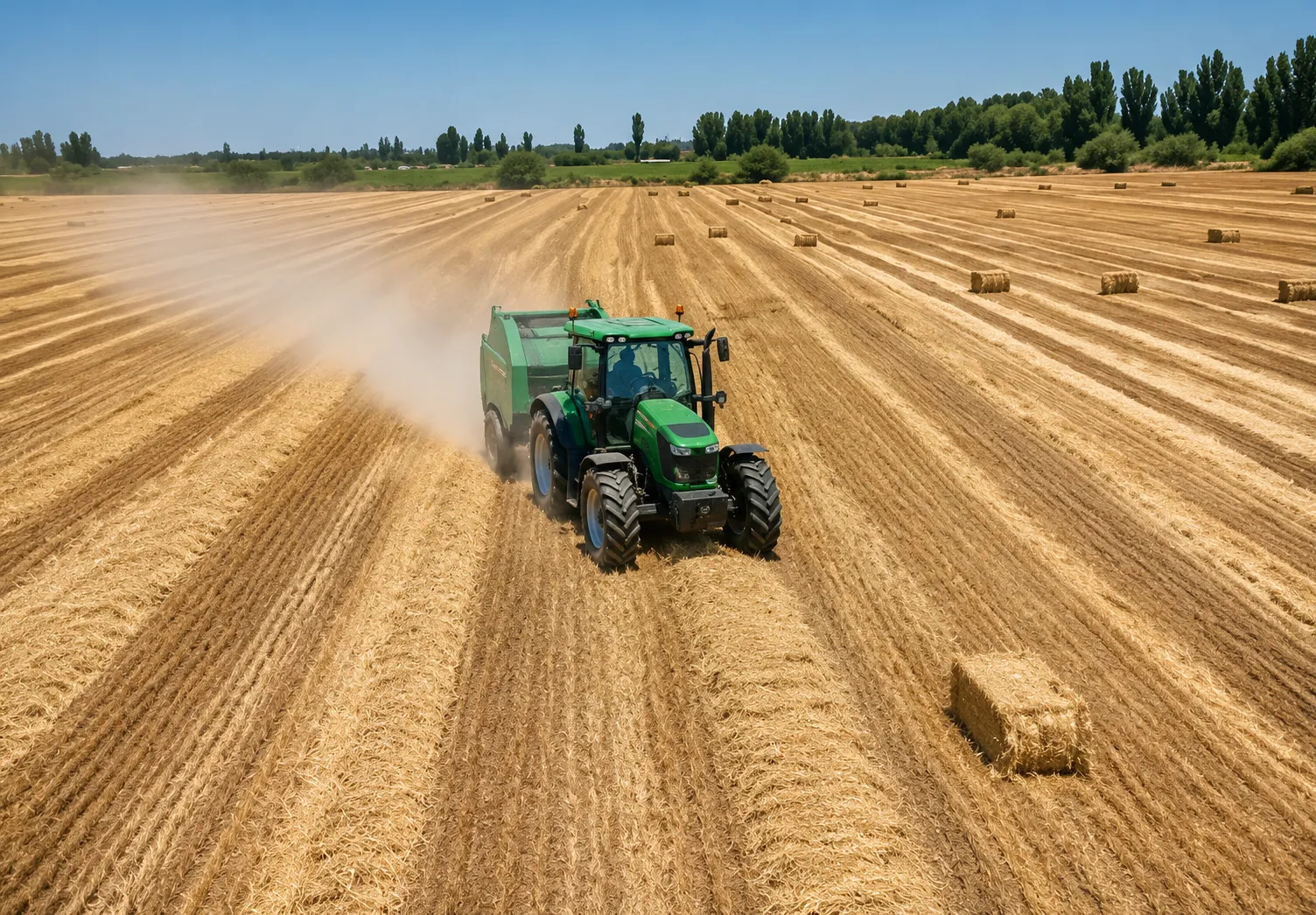
How a Square Baler Works: The Mechanical Principle
Working Principle · Compression Cycle · Knotting Mechanism
Pick-up & Feed Stage
The process starts when the pick-up reel, fitted with spring-loaded tine fingers, lifts windrow material from the ground surface. Rotor speeds are typically calibrated between 65 and 95 rpm to match forward travel speed without bunching or plugging. Material flows upward through a feeder duct where pre-compression augers consolidate the crop before it enters the bale chamber. This pre-compression stage is critical: it eliminates air pockets in the material stream and ensures consistent charge density entering the plunger zone. On high-capacity machines such as those processing moist ryegrass in Wales or damp barley straw in Lincolnshire, the feeder channel geometry directly determines whether the machine maintains output or jams under load.
Plunger Compression Cycle
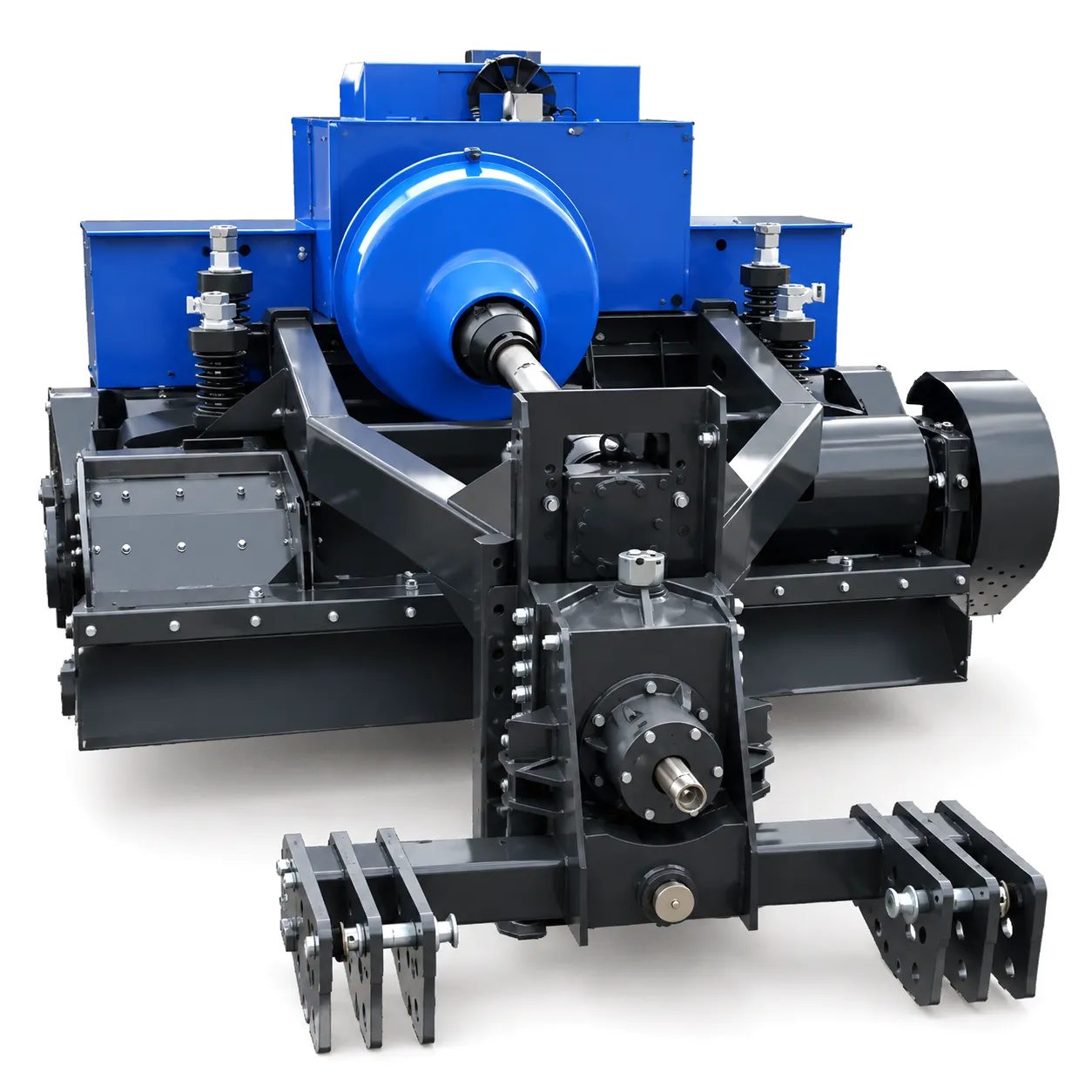
The plunger is the defining component of any square baler. Driven by a heavy-duty crankshaft assembly, the plunger reciprocates at rates commonly ranging from 38 to 60 strokes per minute, compressing each charge of material against the already-formed bale column. Compression pressure is measured in kN and directly controls the final bale density. On premium commercial machines, a density-regulating sensor continuously adjusts the star-wheel tension of the bale chamber walls, allowing operators to target a preset bale weight regardless of variations in crop moisture content. This active density control is what makes modern square balers reliable for straw merchants across Yorkshire who need consistent 200–220 kg bale weights for on-specification sale to equestrian and energy markets.
Knotting & Ejection System
When the bale reaches its preset length, the metering wheel triggers the knotting cycle. A set of needles threads twine around the bale, and knotter bills — precision-formed from hardened alloy steel — tie, cut, and hold the knot in a sequence that takes less than 0.3 seconds. Knot reliability is non-negotiable. A missed knot at a rate of even one in five hundred bales translates to lost product, field delays, and damaged commercial relationships. Quality square balers use knotters manufactured to sub-millimetre tolerances, with wear-resistant bill surfaces and positively located twine discs. After knotting, the completed bale is ejected through the rear chute, onto the field or directly onto a following bale sledge or accumulator trailer — a workflow particularly common among large-scale contractors servicing multiple farms across East Midlands holdings.
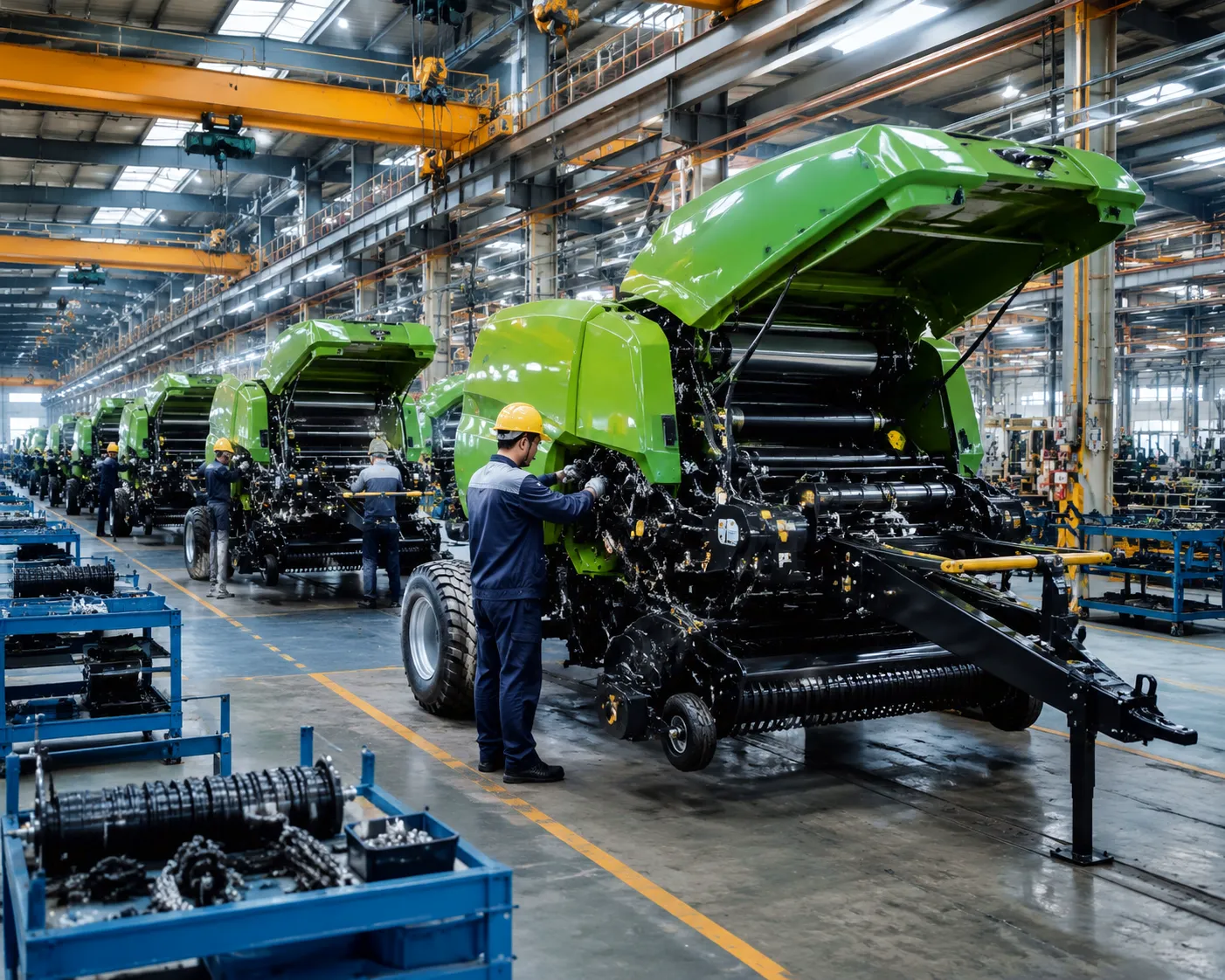
Core Materials: What Commercial Durability Is Built From
Structural Steel · Hardened Components · Surface Treatment
Technical Advantages of Modern High-Density Square Balers
Product Advantages · Performance Differentiators
Active Density Control
Sensor-driven side-wall tension adjustment maintains consistent bale weight across variable crop conditions — straw, hay, haylage — without manual intervention. This removes operator variability from the equation and ensures on-specification bales for commercial sale. UK straw merchants and equestrian supply businesses routinely cite consistent bale weight as their single most important procurement criterion, and active density control is the engineering answer to that demand.
Reinforced Crankshaft Assembly
A forged and balanced crankshaft running in sealed spherical roller bearings eliminates the harmonic vibration that degrades cheaper baler frames over a working season. Bearing life on quality machines exceeds 3,000 operating hours before scheduled replacement — meaningful on a machine that may accumulate 800 hours per year on a busy contract operation. The crankshaft geometry on Ever Power models is designed with a 20° offset crank pin to spread the compression force peak over a broader crank angle, reducing instantaneous torque demand on the PTO and tractor driveline.
Precision Knotter Reliability
A missed-knot rate of under 1 in 2,000 bales, achievable with quality-manufactured knotter bills and correctly tensioned twine discs, is the performance standard commercial operators should demand as a minimum. Ever Power knotters are machined from EN36 case-hardened steel, with the bill and disc geometry optimised through finite element analysis of twine tension profiles. This produces clean, tight knots consistently across the full range of approved twine grades, including the sisal and polypropylene twines most commonly used by UK contractors.
Breites Erntespektrum
A properly configured square baler handles a significantly wider range of materials than many operators realise. Beyond wheat straw, barley straw, and meadow hay — the traditional staples of British arable and livestock farms — modern high-density models process oilseed rape straw, miscanthus energy crop, hemp fibre, cardboard at recycling facilities, and shredded timber residue at biomass plants. Interchangeable pick-up widths, adjustable feeder rotor speeds, and crop-specific chamber profiles allow a single machine to work efficiently across these varied applications without major reconfiguration downtime.
Low PTO Power Demand
Through optimised flywheel sizing (typically 480–560 kg mass), a quality square baler stores peak crankshaft energy mechanically and releases it smoothly during the power stroke, allowing operation on tractors with PTO ratings as low as 65 kW — meaningfully reducing the capital cost of the complete harvesting combination. This is especially relevant in the UK market, where many mixed farms run tractors in the 75–110 kW range and cannot justify the purchase of a dedicated high-horsepower unit for baling duties alone.
Centralised Lubrication & Service Access
A single-point automatic lubrication system distributes grease to all major bearing points on a timed cycle during operation, eliminating the daily manual greasing routine that historically consumed thirty minutes of a machinery operator’s morning. Service access panels are positioned for reach from ground level without ladders, and the knotter service platform on premium models allows a standing operator to inspect, adjust, and replace knotter components in under twenty minutes. These service design decisions translate directly into reduced labour cost per tonne baled on large UK contract operations.
Technical & Performance Specification Table
Key parameters for high-density square baler selection — commercial grade
| Parameter | Specification / Range | Notes |
|---|---|---|
| Bale Chamber Cross-Section | 460 × 360 mm / 560 × 460 mm | Standard small-square / large commercial sizes |
| Bale Length (adjustable) | 400 – 1,300 mm | Metering wheel-controlled; field-adjustable |
| Kolbenhubgeschwindigkeit | 38 – 60 strokes/min | Crankshaft-driven; flywheel-regulated |
| Peak Compression Force | 80 – 280 kN | Adjustable via chamber wall tension springs |
| Bale Density (wheat straw, 15% MC) | 160 – 230 kg/m³ | Operator selectable via density control |
| PTO Input Speed | 540 rpm (std) / 1,000 rpm (option) | 6-spline 1-3/8″ or 1-3/4″ shaft |
| Required Tractor PTO Power | 65 – 160 kW | Model-dependent; flywheel offsets peak demand |
| Schwungradmasse | 380 – 580 kg | Cast iron; dynamically balanced |
| Pick-up Width | 1,700 mm / 1,900 mm / 2,200 mm | Spring tine; swath width matched |
| Anzahl der Knoten | 2 (small) / 4 (large-bale models) | EN36 case-hardened bill steel |
| Frame Steel Grade | Q345 / S355 structural steel | Yield strength ≥ 345 MPa; full-pen welds |
| Surface Treatment | Zinc phosphate + epoxy primer + PU topcoat | ≥ 80 µm DFT; 500 h salt-spray (ISO 9227) |
| Theoretical Output Capacity | 10 – 25 t/h (dry matter basis) | Crop and forward speed dependent |
| Machine Mass (operational) | 1,850 – 4,600 kg | Model range; verify ballast requirements |
Application Scenarios: Where Square Balers Deliver Results
UK-Relevant Industrial & Agricultural Application Sectors
🌿
Hay & Haylage Production — Yorkshire Dales and Scottish Borders
Upland grass farms in the Yorkshire Dales, Cumbria, and the Scottish Borders rely on square balers for making traditional meadow hay and wrapped haylage for winter livestock feeding. The key challenges here are moisture variability — grass cut from north-facing fields may be significantly wetter than adjacent south-facing cuts — and the logistical requirement for bales that can be handled by compact telehandlers in narrow farm buildings. Bale length settings in the 1,000–1,100 mm range are typical for livestock feeding operations, and machines must handle material at moisture contents up to 40% for haylage without compaction-induced plugging.
⚡
Biomass Energy Crop Baling — Miscanthus and Short-Rotation Coppice
The expansion of biomass energy generation across the UK, particularly at power stations in Yorkshire, the West Midlands, and Wales, has created substantial demand for square-baled miscanthus and energy crop straw. These materials present very different characteristics to cereal straw: high silica content in miscanthus causes accelerated wear on pick-up tines and feeder auger flights, while short-rotation coppice chip can bridge in the feeder channel if the rotor pitch is not correctly set. Ever Power designs its energy crop baler configurations with hardox-lined feeder ducts and replaceable auger flight segments specifically to address this wear profile, providing operators supplying Drax and similar facilities with machines that hold their output across a full harvest season without unscheduled downtime.
♾
Recycling & Waste Paper Baling — Industrial Sites Near Birmingham and Sheffield
Industrial-grade square baling machines adapted for recycling applications are increasingly common at paper and cardboard recovery facilities across the West Midlands and South Yorkshire. These fixed or semi-mobile installations compress cardboard, paper stock, and light plastic film into densely bound bales for freight-efficient onward shipment. In this context, the square baler must meet different criteria than an agricultural machine: higher compression force to achieve the 300–400 kg/m³ densities needed for transport efficiency, reinforced ejection channels to handle bales with metal staples or adhesive tape inclusions, and dust-sealed electrical components for operation in environments with paper fibre dust.
🎶
Hemp Fibre Processing — Industrial Hemp Licenced UK Operations
Licensed industrial hemp cultivation has grown steadily across counties in southern England and the East Midlands, with fibre processors requiring tight, consistently weighted bales that maintain their form during the retting and decortication process. Hemp stalk presents a particularly demanding baling challenge: long fibre length causes tangling in the feeder rotor, and the woody core — the hurds — can jam feeder channels designed only for cereal straw. Custom intake geometry with increased clearance between pick-up tines and the feeder rotor housing, combined with a slower-speed pre-compression auger, resolves these issues and makes the machine viable for this emerging sector of UK agriculture.
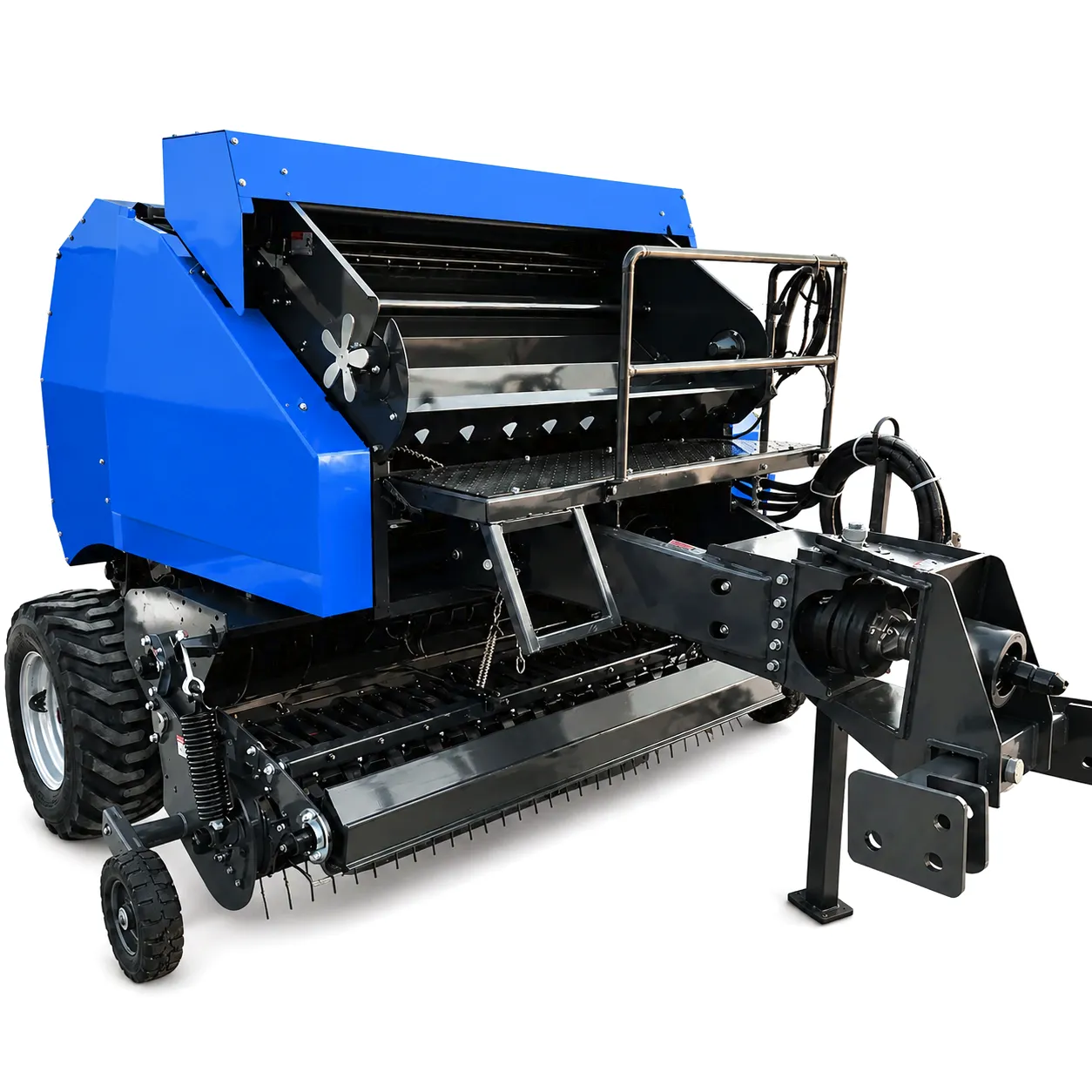
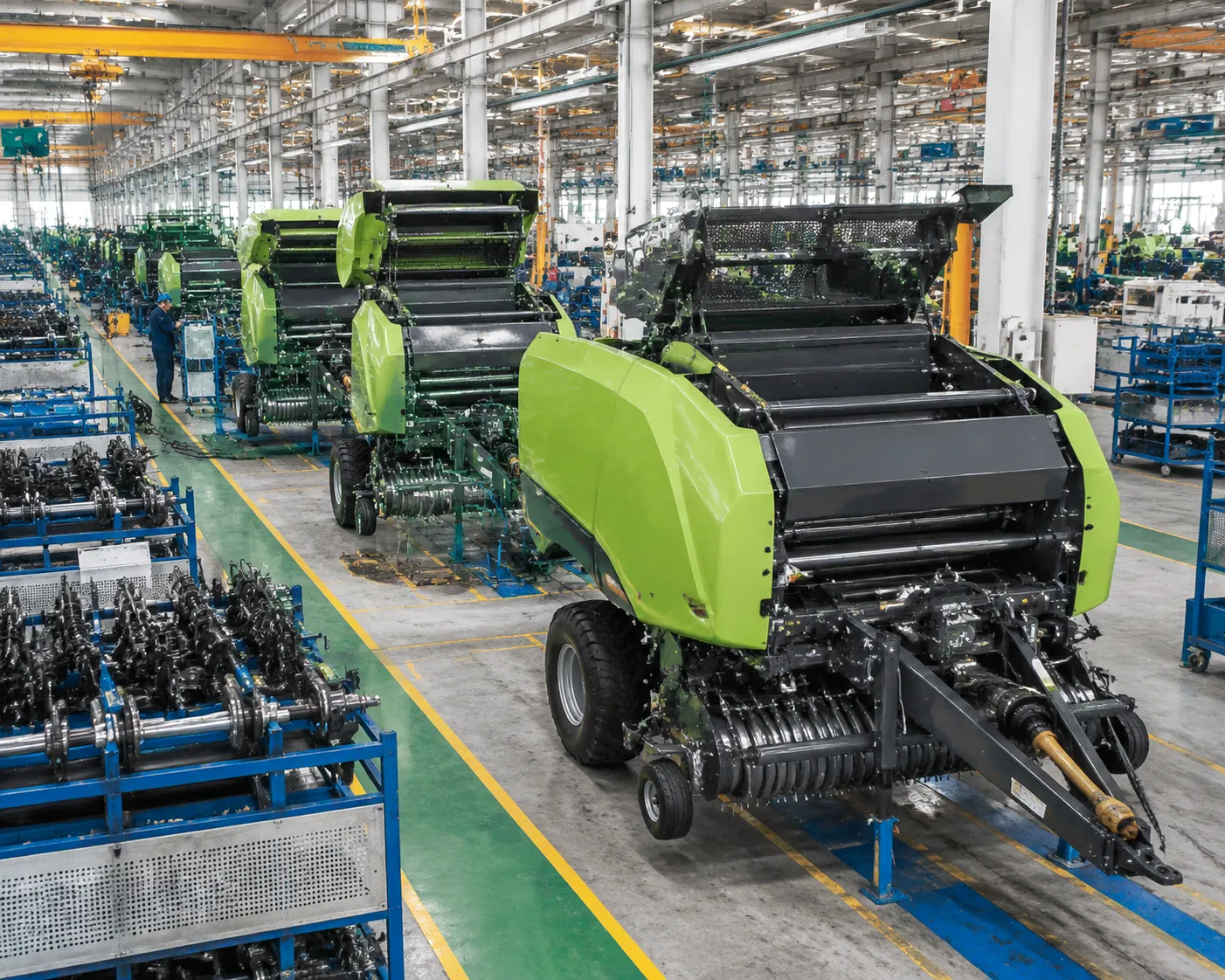
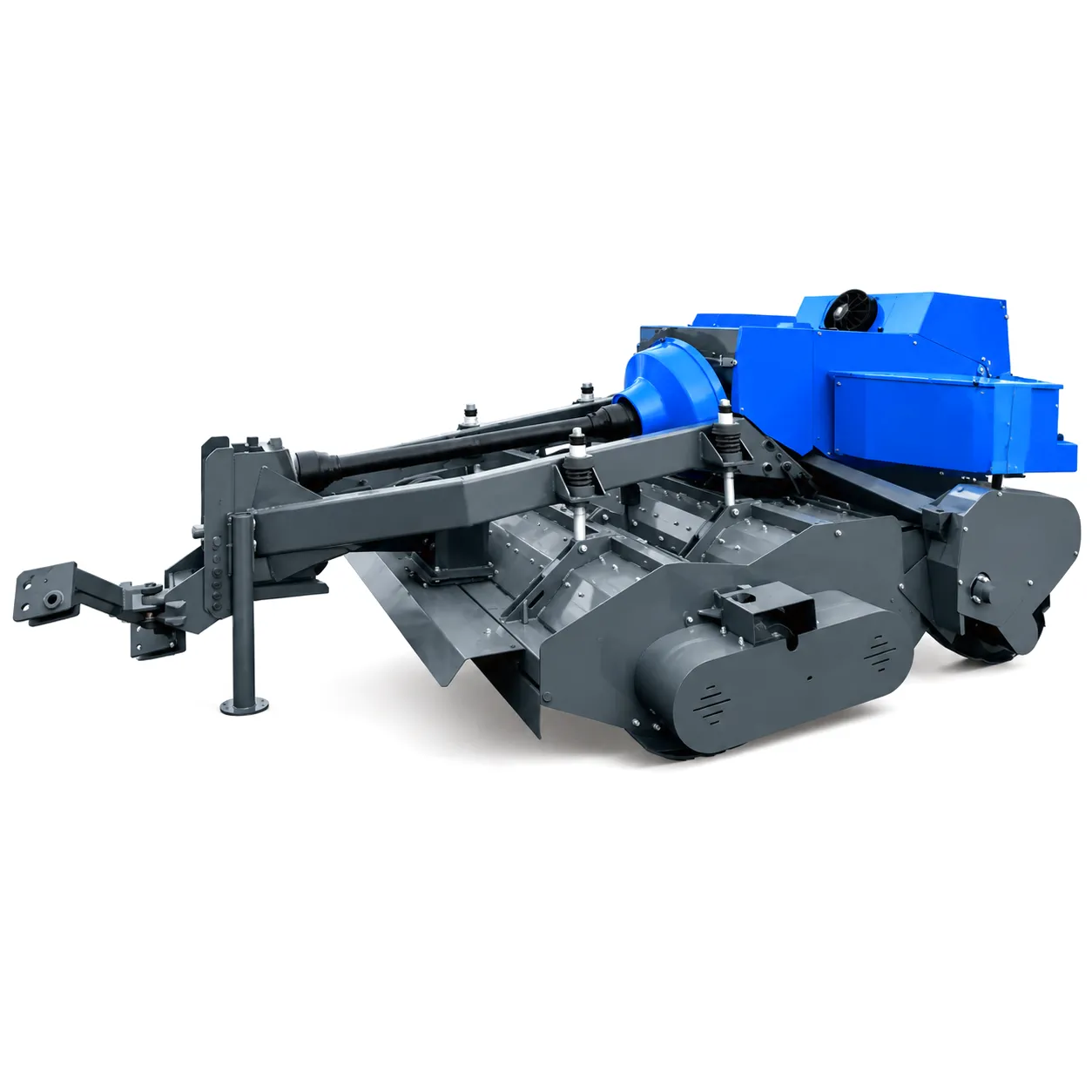
Ever Power: Manufacturing Excellence & Customisation Capability
Factory Capability · Precision Engineering · Custom Square Baler Supply
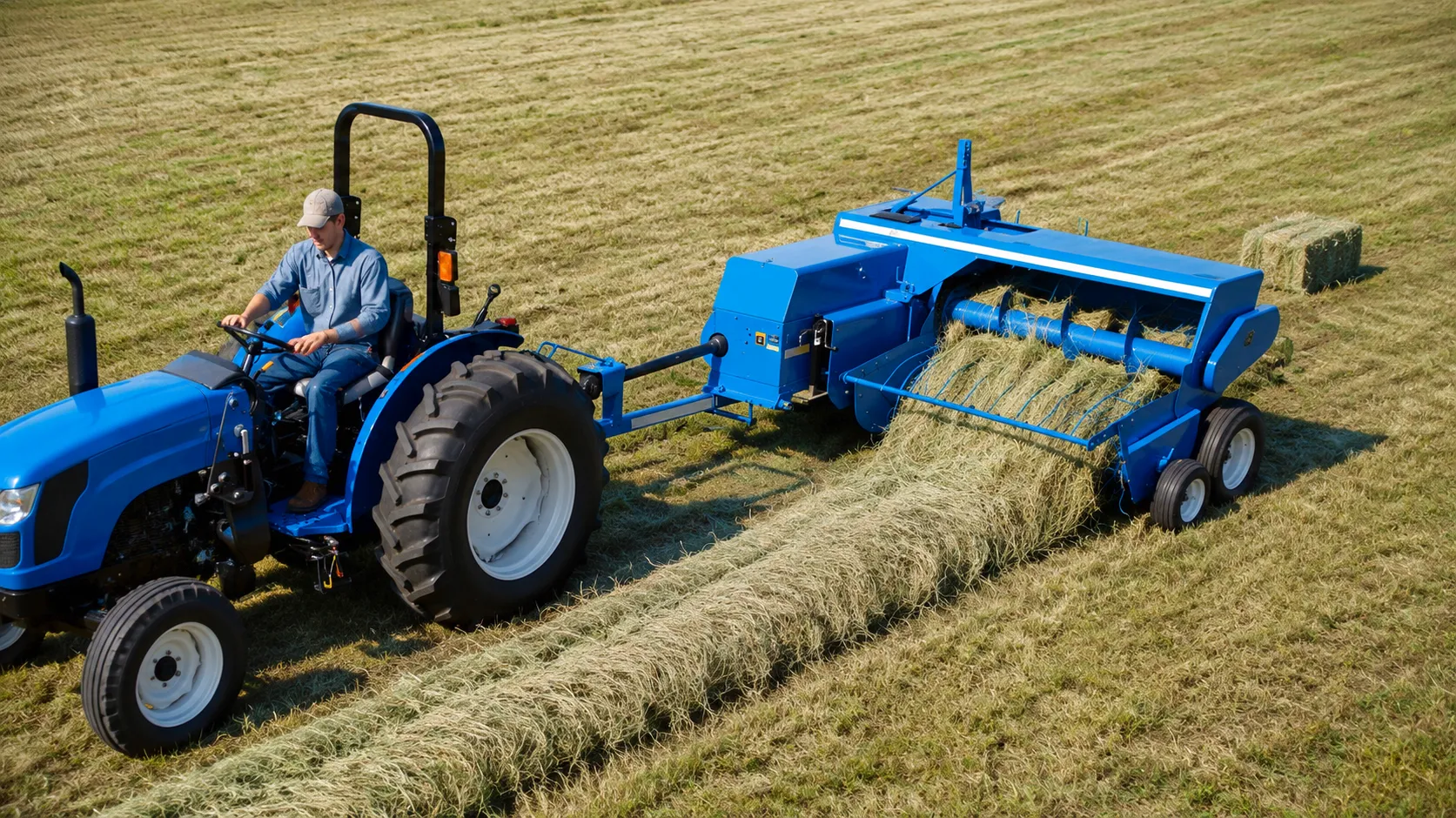
Ever Power Square Baler Product Range
Two proven commercial platforms — configured for UK conditions
9YF-2200/1900/1700 Quaderballenpresse
The 9YF series is Ever Power’s core high-volume platform, available in three pick-up width configurations — 2,200 mm, 1,900 mm, and 1,700 mm — to match swath widths across the full range of UK arable and grass crops. With a plunger stroke rate of up to 58/min, reinforced crankshaft assembly, and the choice of single or dual shredding mechanism for reduced bale weight and improved fermentation in haylage applications, the 9YF delivers the kind of field-proven reliability that large-scale contractors in East Anglia and the East Midlands demand from a primary baling platform. CE certified, PTO 540 rpm standard, full spare parts support available ex-UK warehouse.
9YFS-2.2 Doppelkammer-Quaderballenpresse
The 9YFS-2.2 represents Ever Power’s most technically advanced square baler configuration, featuring a patented dual bale chamber system that produces two bales per ejection cycle — effectively doubling throughput capacity without increasing forward speed or PTO demand. For high-volume contractors working under time pressure during short UK harvest windows, this output advantage can represent the difference between completing a client’s acreage within weather windows or requiring a second pass. The double-chamber system maintains independent density control for each chamber, ensuring that both bales ejected in each cycle meet specification. This model is particularly well-suited to large arable estates in Yorkshire, Northumberland, and the Scottish lowlands where daily throughput is the governing operational constraint.
Customer Success Story: Yorkshire Biomass Contractor Case Study
Real-world performance · UK customer · Biomass supply chain application
Ingleborough Agricultural Contracting, a family-run operation based near Skipton in North Yorkshire, supplies baled miscanthus and energy straw to a biomass power plant in the Humber region under a three-year supply contract. Prior to 2023, they operated two older European-manufactured square balers, both of which suffered recurring knotter failures when processing miscanthus — the high-silica stems caused accelerated wear on the knotter bill surfaces, and the consequent missed-knot rate of approximately 1 in 180 bales was generating significant re-baling cost and occasional contract penalty deductions.
In early 2024, the operation’s machinery manager contacted Ever Power following a recommendation from another Yorkshire contractor who had operated an 9YF-2200 for two seasons on cereal straw. After detailed technical discussion about the miscanthus application — including fibre silica content data and the specific bale density requirements specified in the biomass supply contract — Ever Power proposed a modified 9YF-2200 with Hardox 400 lined feeder duct, slow-speed pre-compression rotor, and upgraded EN36C knotter bills with an extended surface hardening depth of 1.8 mm. Two machines were ordered with an agreed 38-day delivery commitment.
Both machines arrived on schedule, with full CE documentation and a pre-shipment inspection report. Commissioning was completed in two days with telephone support from Ever Power’s technical team. In the 2024 harvest season, the machines collectively processed 4,800 tonnes of dry miscanthus and energy straw across 54 operating days, with a combined recorded knotter miss rate of zero in approximately 21,000 bales produced. The Hardox lining showed no measurable wear after one full season. The contractor has since placed an order for a third machine — the 9YFS-2.2 double-chamber model — for the 2025 harvest campaign, projecting a 35% increase in daily throughput capacity without adding a second tractor to the operation.
Kundenrezensionen
“We ran two Ever Power 9YF-2200 machines through the entire 2024 miscanthus season — over 4,800 tonnes — without a single missed knot. The Hardox-lined feeder is clearly the right call for energy crops. We had knotter issues every week with our previous machines, and this season we didn’t touch the knotters once between service intervals. The bale density consistency has actually helped us get a better price from the plant because they can predict storage stack weights more accurately.”
James Hartley, Machinery Manager — Ingleborough Agricultural Contracting, Skipton, North Yorkshire
“What impressed me most about dealing with Ever Power was the technical depth of the pre-order discussion. Their engineering team understood the silica wear problem immediately and came back with a specific solution — not just a standard machine. The delivery was on time to the day, CE documentation was complete, and we were baling on day three after arrival. That’s the kind of supplier relationship that makes a real difference when you’re working to a biomass supply contract with penalty clauses.”
Robert Ingleborough, Director — Ingleborough Agricultural Contracting, North Yorkshire
“We’ve just confirmed an order for the 9YFS-2.2 double-chamber model for next season. The projected throughput increase on our existing tractor — without increasing PTO demand — genuinely changes what’s possible in our 10-day Yorkshire harvest window. The spare parts pricing from Ever Power is also very competitive compared with European alternatives; that ongoing cost of ownership calculation was part of why we stayed with the brand for a third machine rather than going back to our previous supplier.”
Margaret Thornton, Operations Co-ordinator — Ingleborough Agricultural Contracting, Skipton
Häufig gestellte Fragen
Voice-search friendly answers for UK buyers and agricultural contractors
How much does a commercial square baler cost to buy from a UK supplier, and what is included in the price?+
Commercial square baler prices from a UK supplier or direct importer vary considerably by size, specification, and configuration. Entry-level small-square machines for smaller UK farms typically start from £28,000–£45,000 ex-works, while large-bale commercial models with active density control and automatic lubrication systems are priced from £55,000–£95,000 and above. For Ever Power models imported direct, pricing is typically 20–35% below comparable European-branded machines at equivalent specification — contact [email protected] for a specific quote with full specification comparison. Quoted prices from Ever Power include CE documentation, pre-shipment inspection report, and basic spare parts kit for first-season servicing.
Which square baler model is best suited for baling miscanthus energy crops in Yorkshire for biomass supply contracts?+
For miscanthus baling in Yorkshire and other UK biomass-producing regions, the Ever Power 9YF-2200 with the Hardox-lined feeder duct and EN36C knotter upgrade is the recommended specification. Miscanthus silica content causes accelerated wear on standard-specification feeders and knotters, and addressing this at the point of order rather than after a season of premature wear is the more cost-effective approach. The 2,200 mm pick-up width also suits the wide miscanthus windrows typically laid by large-disc mowers used in Yorkshire biomass operations. For maximum throughput where tractor availability is a limiting factor, the 9YFS-2.2 double-chamber model offers the highest output per PTO hour in this crop type.
What tractor PTO horsepower do I need to operate an Ever Power square baler efficiently on a UK arable farm?+
Ever Power 9YF series square balers are designed to operate from a minimum PTO output of 65 kW (approximately 87 hp), with optimal performance at 80–110 kW PTO. The flywheel design on these machines stores peak crankshaft energy mechanically, which significantly reduces the instantaneous PTO demand compared with machines that transmit the full compression force directly through the driveline. For cereal straw on typical East Midlands conditions, a 90 kW PTO tractor running at 8–10 km/h forward speed will produce near-maximum output. In dense, wet grass crops — more common in Wales, Scotland, and the north of England — a PTO rating of 100 kW or above is recommended to maintain forward speed without overloading the tractor.
Where can I get a competitive price quote for a square baler from a reliable manufacturer who can deliver to the UK within a reasonable lead time?+
Ever Power provides direct manufacturer pricing for UK buyers through [email protected]. Lead times for standard catalogue configurations are 28–42 days from confirmed order to port loading, with delivery to UK ports (Immingham, Tilbury, or Grimsby are most commonly used) typically adding 18–24 days transit. Custom-specification machines — including pick-up width, bale chamber size, PTO shaft standard, and application-specific wear packages — are available at 45–65 day lead times. All machines arrive with CE Conformity Assessment documentation required for UK use under the Machinery Directive retained in UK law, and full pre-shipment inspection reports are provided as standard.
How does a double-chamber square baler work, and is it worth the extra cost for a large-scale UK arable contracting business?+
A double-chamber square baler, such as the Ever Power 9YFS-2.2, uses a single pick-up and feeder system to simultaneously fill two independent bale chambers positioned side-by-side. Each chamber has its own plunger, density control system, and knotters — the two chambers are driven from a common crankshaft but operate independently. The result is that every forward pass over a windrow produces two completed bales rather than one, effectively doubling throughput at the same forward speed and PTO input. For UK arable contractors facing short weather windows — particularly during the unpredictable summer harvest periods common in Yorkshire and the North — the productivity advantage is substantial. The premium over a single-chamber machine is typically 40–60% of the base machine price, which payback analysis shows is recovered in 2–3 seasons for operations producing over 6,000 bales per year.
What maintenance schedule should I follow to keep a commercial square baler in reliable working condition through a long UK harvest season?+
A commercial square baler operating through a UK harvest season requires daily, 50-hour, and 500-hour service intervals as a minimum framework. Daily checks cover pick-up tine condition, twine tensioner settings, knotter cleanliness, oil levels, and driveline guard integrity. At 50-hour intervals, all non-automatically-lubricated pivot points are greased, the knotter bill timing is checked, and the PTO shaft universal joints are inspected for wear. At 500 hours — or at season end — the plunger slide surfaces, crankshaft bearing clearances, pick-up tine carrier bearings, and feeder rotor drive chain are fully inspected and replaced as necessary. Ever Power supplies a UK-format service schedule in the machine documentation and offers pre-season and post-season service kits packaged specifically for each model.
Who should I contact to get a technical specification review and custom square baler quote for an industrial hemp fibre baling application in England?+
For non-standard applications including industrial hemp fibre baling, the technical review process at Ever Power begins with an application data sheet covering crop characteristics (fibre length, stem diameter, moisture content at baling, target bale density) and operational parameters (available tractor PTO, daily output target, site constraints). This information allows the engineering team to propose the correct pick-up rotor clearance, pre-compression geometry, and chamber profile for the specific material — rather than supplying a standard agricultural configuration that may not perform reliably. Email the application data to [email protected] and request a Custom Application Review; the engineering team typically responds within 3 business days with a specification proposal and budgetary pricing.
Ever Power — Professional Square Baler Manufacturer · CE Certified · UK Export Supply
Technical enquiries & quotations: [email protected]
bearbeitet von gzl