Technical Deep Dive · Agricultural Machinery
Square Baler Technology:
Engineering, Performance & UK Applications
From crop compression mechanics to field-ready configurations — a comprehensive technical guide for agricultural professionals and procurement engineers across the United Kingdom.
Square balers have shaped the rhythm of British agricultural harvesting for decades, and yet the engineering that goes into a modern unit is anything but ordinary. Whether you are managing a mixed arable operation in the Yorkshire Wolds, running a contracting business in Lincolnshire, or supplying biomass producers in the East Midlands, the quality and reliability of your square baler determine not just productivity, but profitability. A machine that loses even two hours of output during peak silage or straw season can cascade into significant financial loss across a large-scale operation.
Modern square balers are precision compression machines, engineered to handle diverse crop types at high throughput rates while consistently delivering bales of uniform density and dimension. They are specified not merely by chamber size or PTO requirement, but by their ability to sustain output in variable field conditions — wet straw in the fens, heavy ryegrass in the Welsh borders, or dense miscanthus in the Midlands energy corridors. This guide provides an in-depth technical breakdown of how square balers work, the materials that define their longevity, and the specific performance characteristics that matter most to UK buyers.
사각 베일러 작동 원리: 기계적 원리 설명
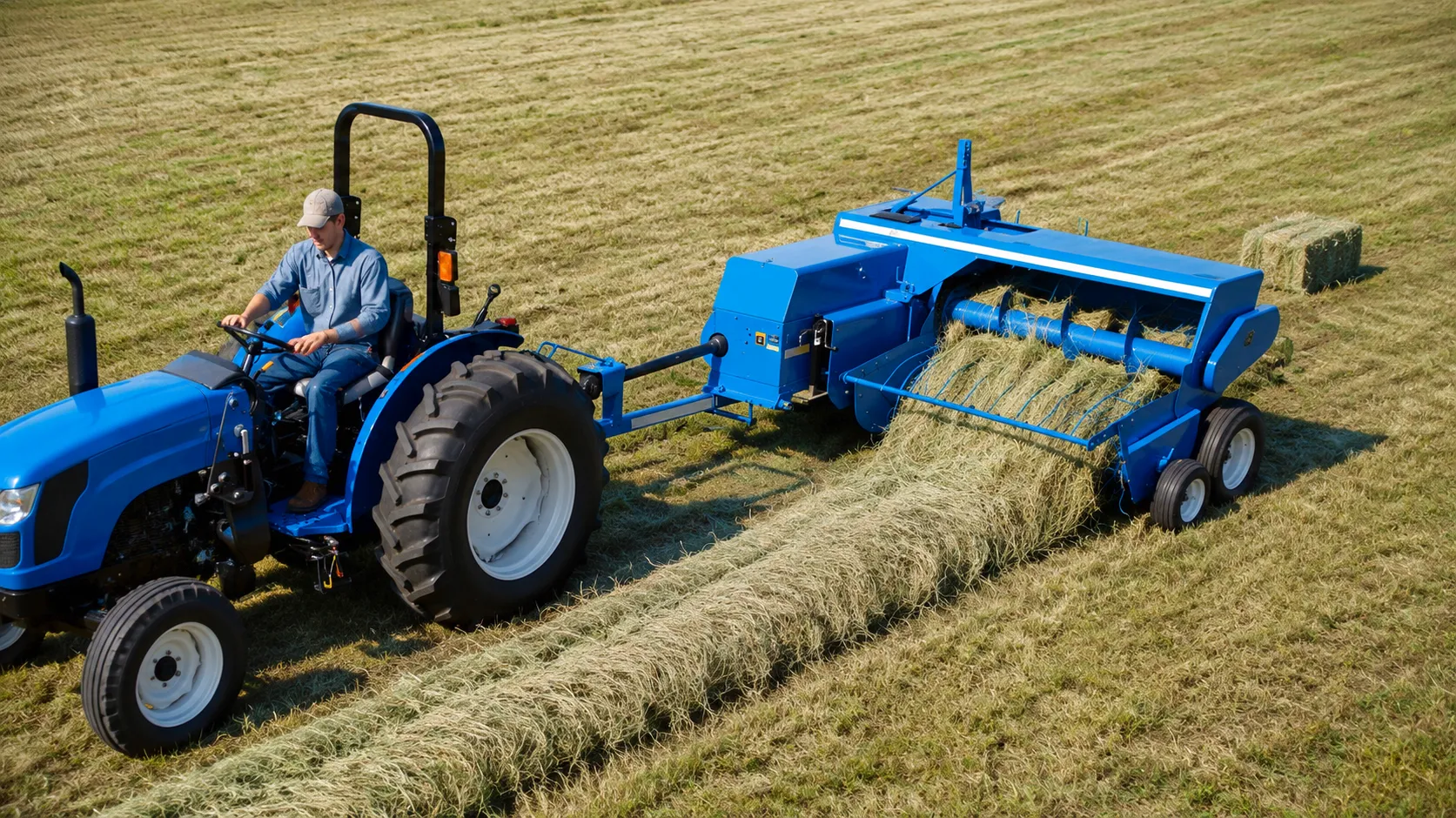
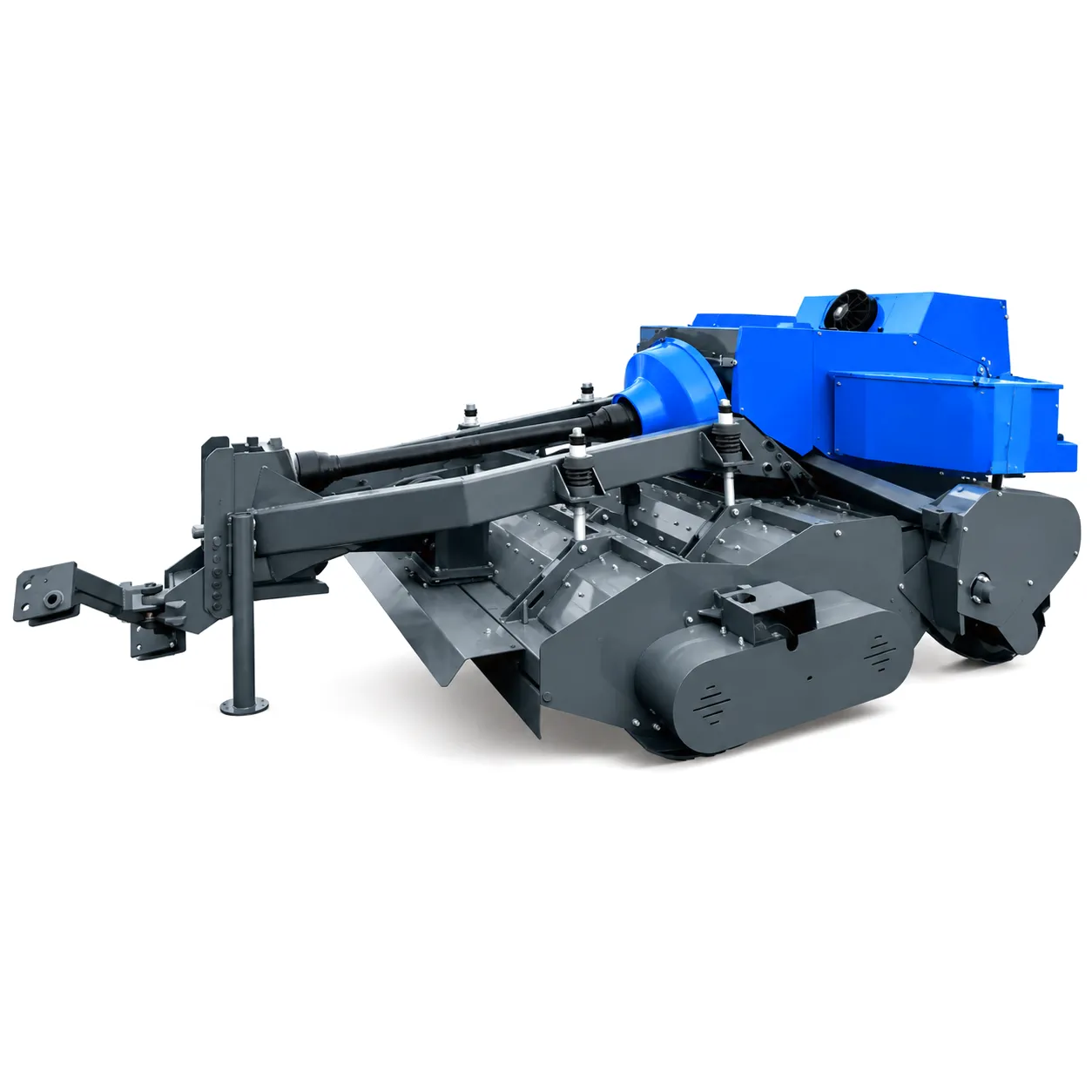
The square baler operates on a reciprocating plunger compression system. Crop material is gathered from the windrow by a pickup reel — a rotating cylinder fitted with spring-steel tines that lift material off the ground and feed it into the machine. From there, a crop transfer system, typically an auger or feed rotor, moves the gathered material sideways into the pre-compression chamber. This staging area accumulates a charge of crop material until sensors or mechanical stops determine that sufficient volume has built up to justify a compression stroke.
Once triggered, the stuffer mechanism — a fork or ram — drives the accumulated charge up into the main bale chamber. Inside the chamber, the plunger advances on a crankshaft-driven stroke, compressing the charge against the previously formed bale. This stroke is continuous throughout operation: each plunger cycle adds one more compressed layer, building the bale section by section. The bale length is monitored either by a star-wheel meter or a digital counter calibrated to crop density. When the set length is reached, the knotting mechanism engages, tying off the bale with twine and cutting it cleanly. The completed bale is then ejected from the rear of the machine, and the next bale begins forming immediately.
⚙
Pickup Reel
Spring-steel tines lift crop from windrow. Cam-controlled tine pitch adjusts for varied crop volumes and ground contour.
🔄
Pre-compression Chamber
Accumulates and meters crop charges before each plunger stroke, ensuring consistent bale layer density from first to last.
⛡
Reciprocating Plunger
Crankshaft-driven; delivers controlled compression force per stroke. High-tensile steel construction handles peak loads without deflection.
🖊
Double-Knot System
Billhook knotters tie both top and bottom twine simultaneously. Precision timing ensures clean cuts and secure knots at full operating speed.
Industrial & Agricultural Application Scenarios
Square balers serve a wide range of sectors across the United Kingdom — from traditional cereal farming to specialised renewable energy supply chains.
Application Scenario 1: Cereal Straw Baling in Lincolnshire and the East Riding of Yorkshire
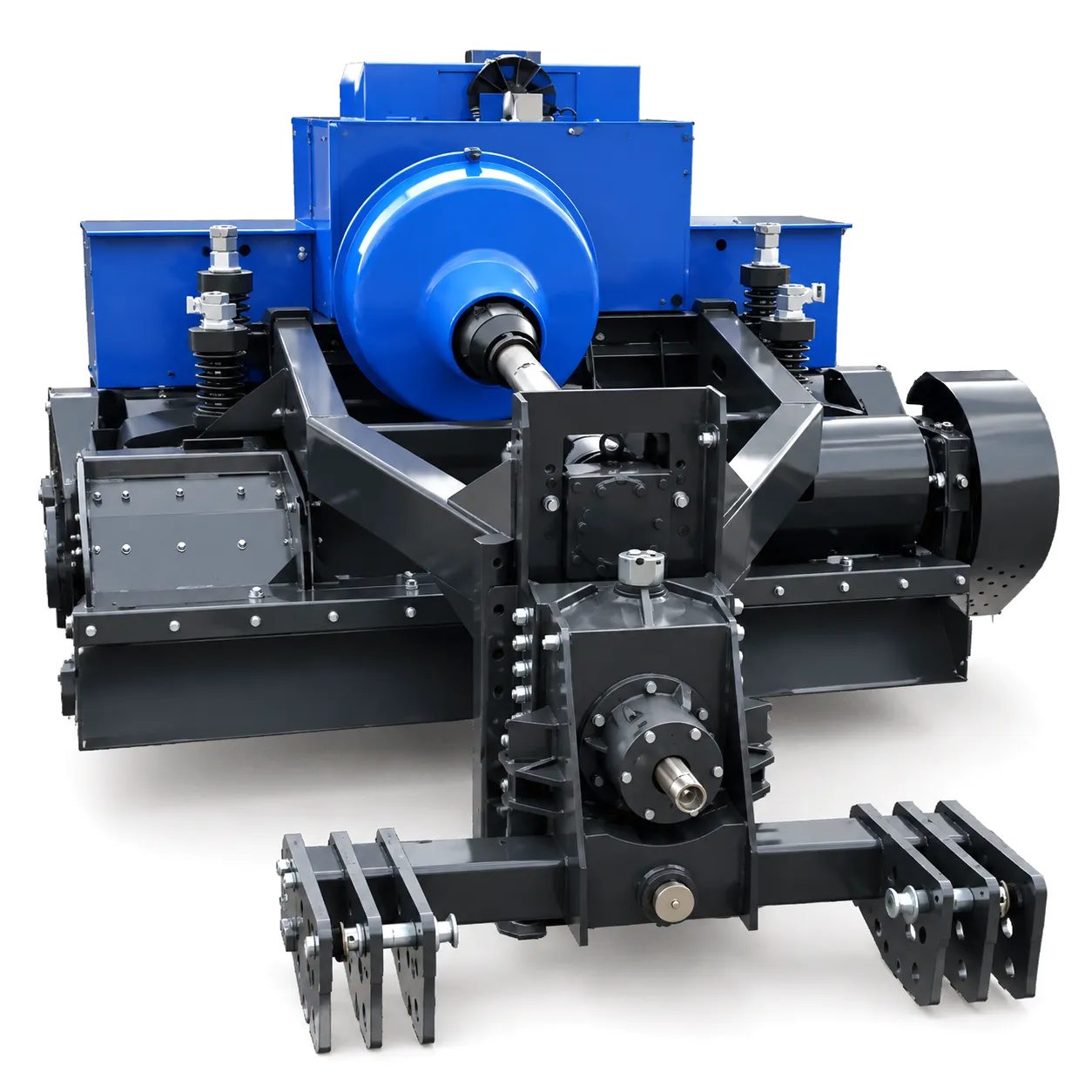
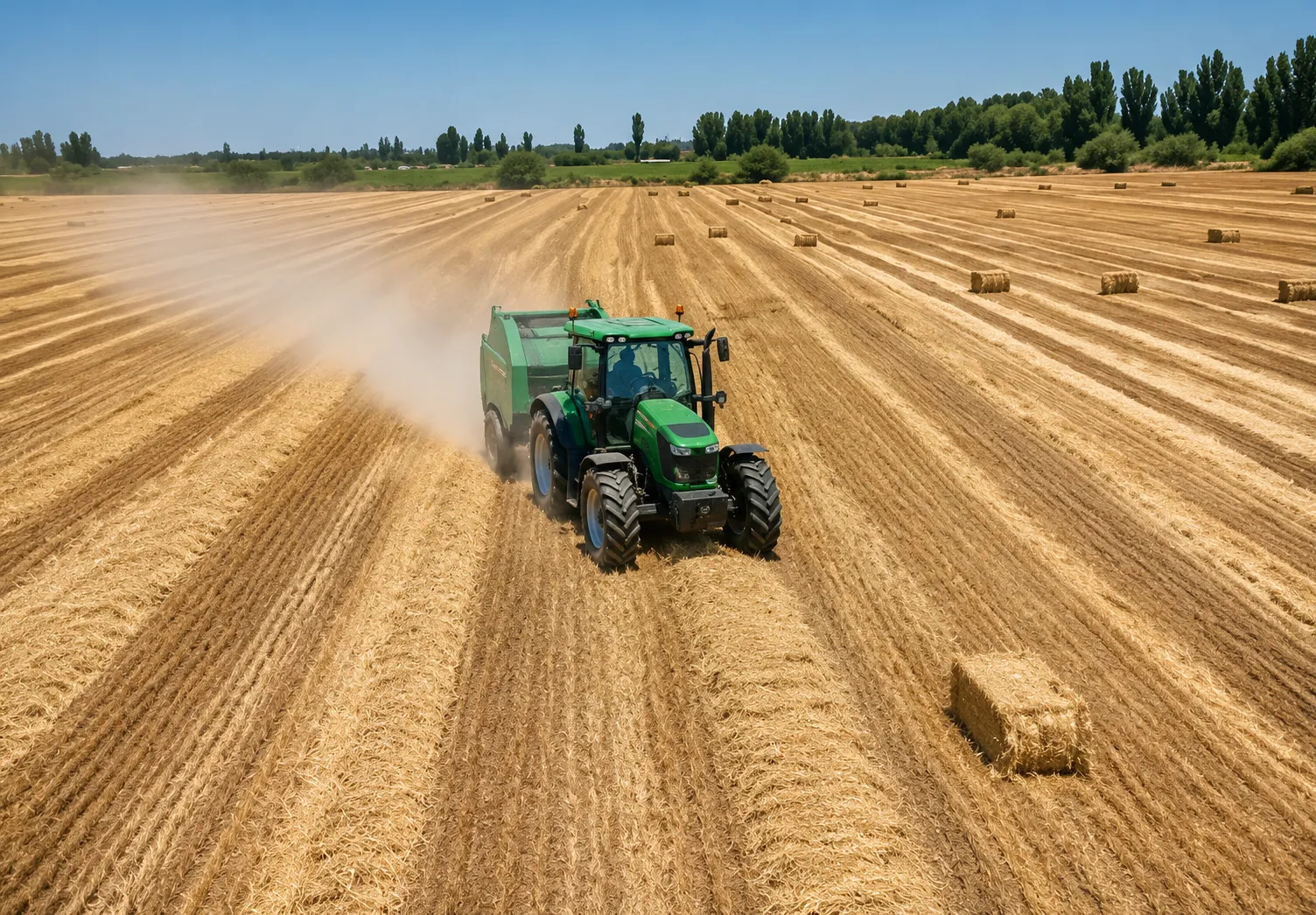
Cereal straw baling remains the highest-volume application for square balers across the United Kingdom’s arable heartlands. In Lincolnshire, the UK’s largest cereal-producing county, and in the broad flat fields of the East Riding of Yorkshire, harvest windows are tight — often just 10–14 days of suitable baling weather between cutting and autumn cultivation. Square balers in this context need to sustain throughput rates that match or exceed the combine harvester’s output, particularly on farms running multiple machines to clear thousands of hectares before the weather breaks.
Large square bales — typically 1.2 m x 0.9 m x 2.4 m — are the preferred output here because they stack efficiently in a standard 13.6 m curtain-sided lorry, minimising the number of haulage movements required to transport straw from field to storehouse or to bedding customers in the livestock sectors of North and West Yorkshire. A baler with 2,200 mm pickup width working at 65 strokes per minute can clear a 120-hectare field’s straw in a single day’s operation — a benchmark that genuinely separates productive machines from marginal ones in this demanding environment.
Application Scenario 2: Miscanthus and Energy Crop Baling for Biomass Heating Plants in the East Midlands
The UK government’s ongoing commitment to renewable heat through the Boiler Upgrade Scheme and previous Renewable Heat Incentive have created a growing market for dense, dimensionally consistent miscanthus and short-rotation coppice bales across the East Midlands. Processing plants in Nottinghamshire, Derbyshire, and Leicestershire require supplier-delivered bales that meet strict moisture content, weight, and geometric specifications that allow automated handling on their intake conveyors. A square baler that produces irregular bale lengths or variable densities creates expensive bottlenecks at intake — problems that quickly translate into price deductions or rejected loads.
Miscanthus presents specific mechanical challenges: the crop’s tough, woody stalks require high plunger compression force (typically 220–260 kN for dense energy bales) and robust stuffer forks capable of handling fibrous material without bridging or clogging. Balers configured for energy crop use often specify wider feed rotors, hardened stuffer fork tines, and enhanced knotter timing to account for the crop’s lower compressibility compared to wheat straw. These technical parameters must be confirmed before procurement, and ever-power engineering teams regularly assist Midlands-based energy crop contractors in specifying the correct configuration for their particular yield and density targets.
Application Scenario 3: Reed Bed and Thatching Material Harvesting in the Norfolk Broads
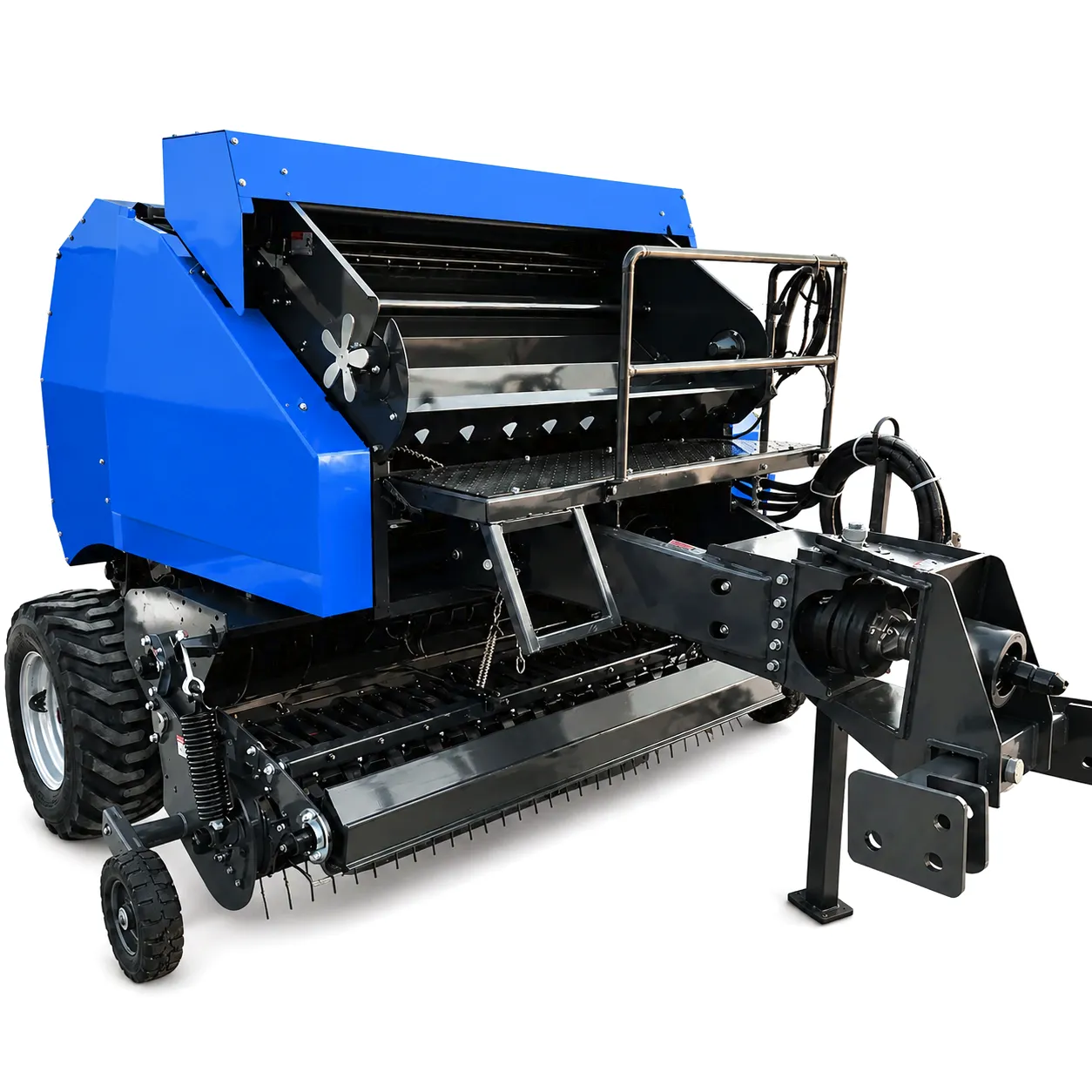
The Norfolk Broads represents a highly specialised but commercially important application zone for square balers adapted for reed and sedge harvesting. Thatching-grade reed (Phragmites australis) commands a premium price in the UK heritage construction market, where it is used on listed buildings, National Trust properties, and new-build country homes. The baler in this application must handle high-moisture, fibrous material carefully, producing bales that preserve the reed’s length and fibre alignment — both of which affect thatching grade quality assessments. Standard cereal baler settings are often unsuitable without modification.
Operators in the Broads typically run balers with lower plunger pressure and reduced stroke rates to prevent crushing the reed stems, which would downgrade the material. Custom pickup tine spacings prevent leaf material separation that reduces bale value. Because the working terrain in the Broads involves soft, sometimes waterlogged ground, balers in this sector need appropriate axle configurations and large-section tyres to prevent bogging — a factor that Ever Power engineering teams address through axle and tyre option packages available as part of the customisation process for UK customers operating in sensitive natural environments.
Application Scenario 4: Hay and Silage Baling for Equine and Livestock Markets in the Scottish Borders and Cumbria
Across Cumbria, Dumfries and Galloway, and the Scottish Borders, a large proportion of agricultural output centres on livestock systems — sheep, beef cattle, and to an increasing extent, the equine market. High-quality hay and wrapped silage for these sectors demands square baler precision that goes well beyond simple density uniformity. Purchasers in the equine supply chain, which includes racing yards in Newmarket and Lambourn, dressage establishments in Cheshire, and riding schools throughout the South of England, require bales of defined dimensions that fit their automated hay feeders and storage systems precisely. An 850 mm x 850 mm x 2,400 mm bale that varies by more than 50 mm in any dimension causes handling problems in these environments.
Silage-configured square balers additionally require the ability to handle pre-wilted grass at moisture contents between 45% and 65% — significantly higher than dry straw — without slippage or uneven compression layers. These conditions place specific demands on the plunger seal design, the feed rotor gap settings, and the twine tension calibration, all of which must be set up by a technically competent operator who understands both the machine’s parameters and the specific crop presentation in that season’s growing conditions.
Ever Power: Precision Manufacturing & Custom Engineering
Built for demanding markets. Configured for your operation.
🏭
Advanced Manufacturing Infrastructure
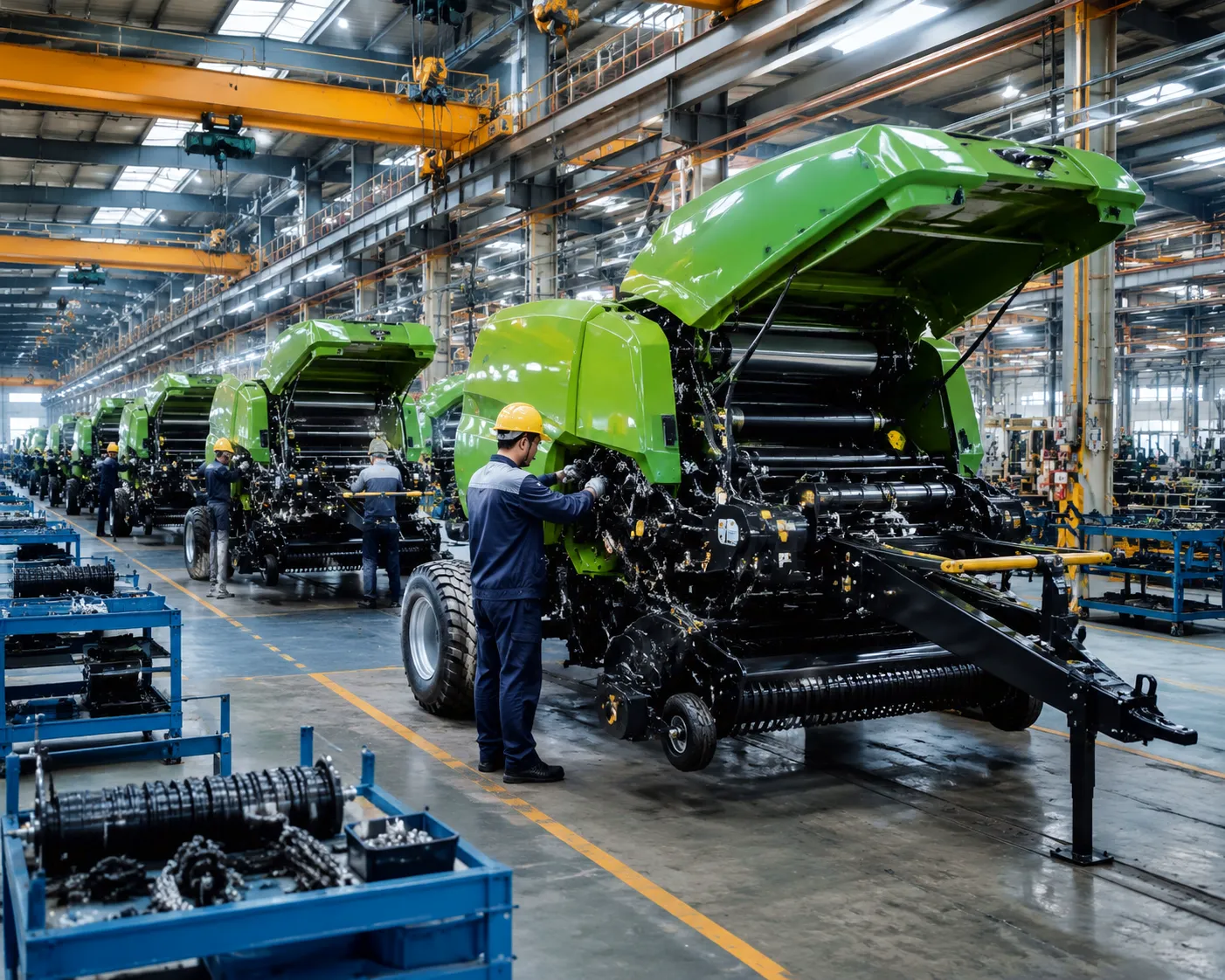
Ever Power’s production facility operates CNC machining centres, robotic welding stations, and automated shot-blasting and coating lines. The production layout follows lean manufacturing principles, with continuous flow from raw material intake through to final assembly, PDI (pre-delivery inspection), and despatch. Every critical weld joint on bale chamber frames is performed by certified robot welding cells, ensuring consistent penetration and fusion quality that manual welding cannot reliably replicate at production volumes. This level of infrastructure investment means lead times on standard configurations remain competitive while quality benchmarks stay consistent across every unit that leaves the factory.
⛭
Deep Customisation Capabilities
Ever Power’s engineering team works directly with UK importers, distributors, and end-users to develop configuration packages tailored to specific crop types, operating conditions, and hitch specifications. This includes custom pickup widths, alternative bale chamber geometries, crop-specific feed rotor profiles, and metric or imperial twine calibration setups. For buyers in the UK market, this means the baler arrives configured for the actual crops and field conditions in their region — not adjusted on-farm after purchase. Custom-build lead times and minimum order quantities are discussed directly with the Ever Power sales team, and most bespoke configurations can be integrated into the standard production schedule without significant premium.
📈
Supply Chain Assurance & Quality Control
Ever Power maintains an established supply chain for critical components — bearings, knotter assemblies, hydraulic cylinders, and PTO drivelines — with multiple qualified suppliers at each tier. This dual-sourcing strategy protects against single-supplier disruption and ensures that production schedules hold even when global component markets tighten. Incoming components undergo dimensional inspection and material certification checks at goods-in. Finished machines go through a structured 32-point PDI process that includes PTO load testing, knotter cycle verification, and bale measurement confirmation before any unit is cleared for shipment to UK customers or their appointed distributors.
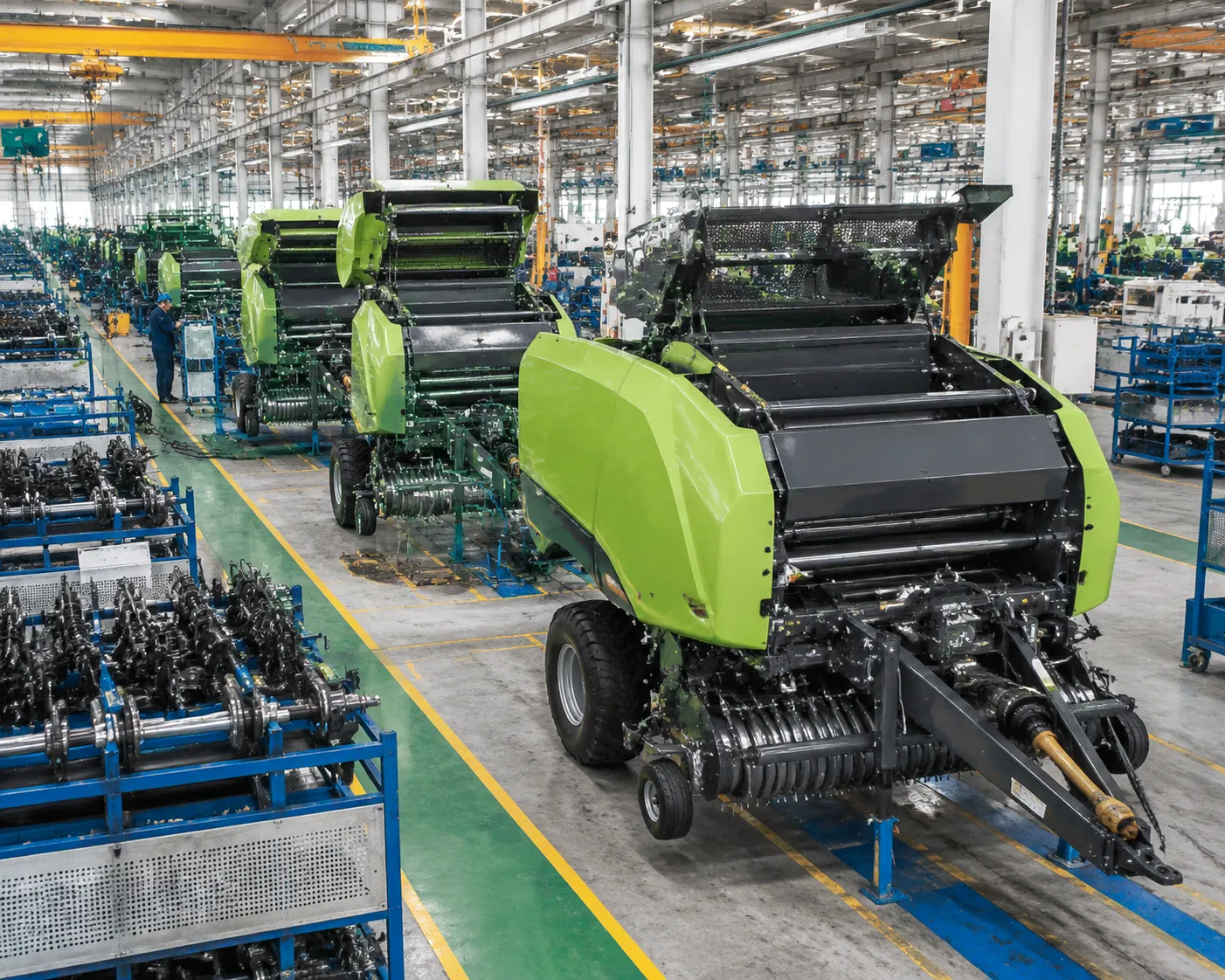
The Ever Power workshop floor reflects a philosophy of precision-first manufacturing. Assembly stations are dedicated to specific machine subsystems — pickup, pre-compression, plunger drive, knotters — allowing specialist technicians to develop deep expertise in each area. This specialisation, combined with standardised work instructions and in-process quality gates, means that every square baler reaching the UK market carries consistent build quality regardless of production run timing or batch volume. For UK buyers who are committing significant capital to new machinery, this manufacturing consistency is not an abstract reassurance — it directly determines the machine’s performance in the first season and its reliability across the following five to eight years of working life.
Customer Success Story: Nottinghamshire Biomass Contracting, East Midlands
Meridian Energy Crops Ltd, based near Newark-on-Trent in Nottinghamshire, operates as an agricultural contracting business specialising in miscanthus and short-rotation willow harvesting for biomass energy customers across the East Midlands. The business serves three principal biomass heating plant operators in the region, each with strict intake specifications for bale weight (minimum 420 kg), bale length (2,200 mm ± 30 mm), and moisture content (maximum 18%). Prior to 2023, the business ran two ageing large square balers from separate manufacturers, both of which required significant seasonal maintenance expenditure and regularly produced bale dimensions outside the purchasers’ tolerances — leading to intake disputes and retroactive price adjustments that damaged the operation’s margins.
Working through an established UK agricultural machinery importer, Meridian’s operations director contacted Ever Power to discuss replacement options. The team at Ever Power recommended two units of the 9YF-2200 configuration with miscanthus-specific feed rotor profiles, enhanced compression force capability (260 kN), and digital bale length control systems calibrated to the purchasers’ intake specifications. A factory visit was arranged prior to order confirmation, during which Meridian’s team reviewed the production facility, inspected materials certifications, and witnessed PDI procedures on machines at the end of the assembly line.
Both machines entered service in spring 2023. Through the first full miscanthus harvesting season, Meridian processed approximately 6,200 tonnes of crop across 340 hectares in Nottinghamshire and adjacent areas of Lincolnshire. Average bale weight came in at 447 kg — comfortably above minimum intake thresholds — and bale length variance was recorded at less than ±18 mm, well within the 30 mm tolerance. Knotter miss-rate across both machines combined was logged at 0.07%, eliminating the manual retying labour that had previously added 2–3 worker-hours per day during peak operation. The improvement in intake acceptance rate removed approximately GBP 28,000 in seasonal price adjustments that the business had previously absorbed. Meridian confirmed a third unit order for the 2024 season.
What UK Customers Say About Ever Power Square Balers
★★★★★
“The knotter reliability on the 9YF-2200 has been outstanding — we ran 8,400 bales in our first season without a single miss-knot. After years of dealing with knotter problems on older machines, that level of performance actually surprised us. The Ever Power team also helped us set up the compression pressure correctly for our crop density before the season started, which made a real difference to the output we were achieving from day one.”
— Robert Hargreaves, Agricultural Contractor
Selby, North Yorkshire
★★★★★
“We run the double-chamber 9YFS-2.2 on our biomass contract and the output rate has genuinely changed the economics of our operation. Being able to process two bale streams simultaneously while keeping within our purchaser’s weight specification took a significant number of tractor hours off the annual schedule. The customisation work that Ever Power did on the feed rotor for miscanthus meant we were getting consistent bales from the first hour of harvesting — no settling-in period. The after-sales technical support has also been responsive whenever we’ve had technical questions between seasons.”
— Sarah Pemberton, Farm Manager
Bourne, Lincolnshire
★★★★★
“What impressed me most was the material quality on the bale chamber. We had a previous Chinese-manufactured baler that had issues with chamber wall deformation after two seasons of heavy straw baling. The Ever Power machine uses significantly heavier plate on the critical wear surfaces and the build quality is visibly better. We’re now two seasons in with no structural issues at all. For the price point, it represents genuinely good value for a UK contractor running it hard through a full harvest programme. The factory visit before ordering also helped us feel confident about what we were buying.”
— James Whitworth, Contracting Director
Spalding, Lincolnshire