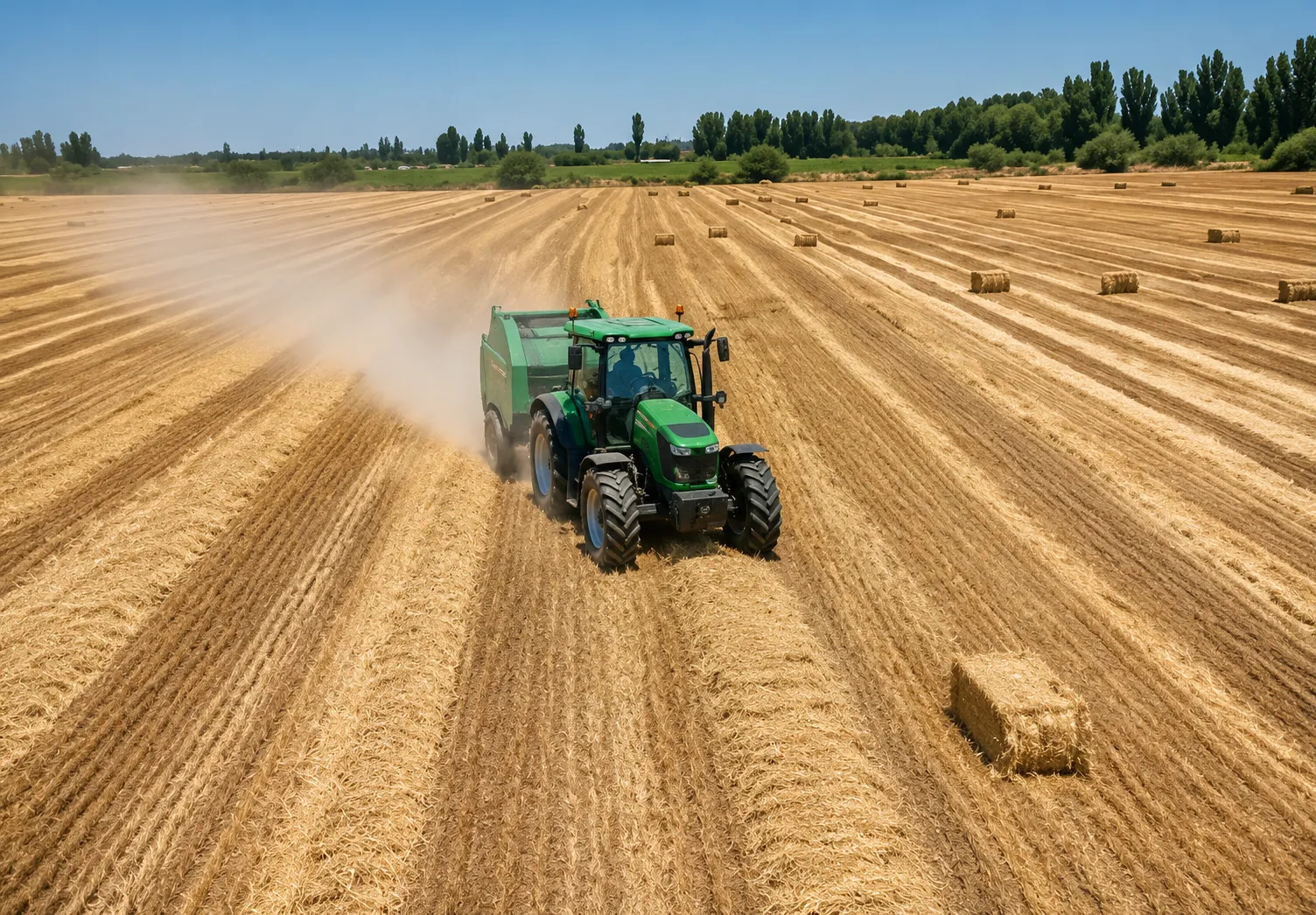
How a Square Baler Works: The Reciprocating Plunger Principle
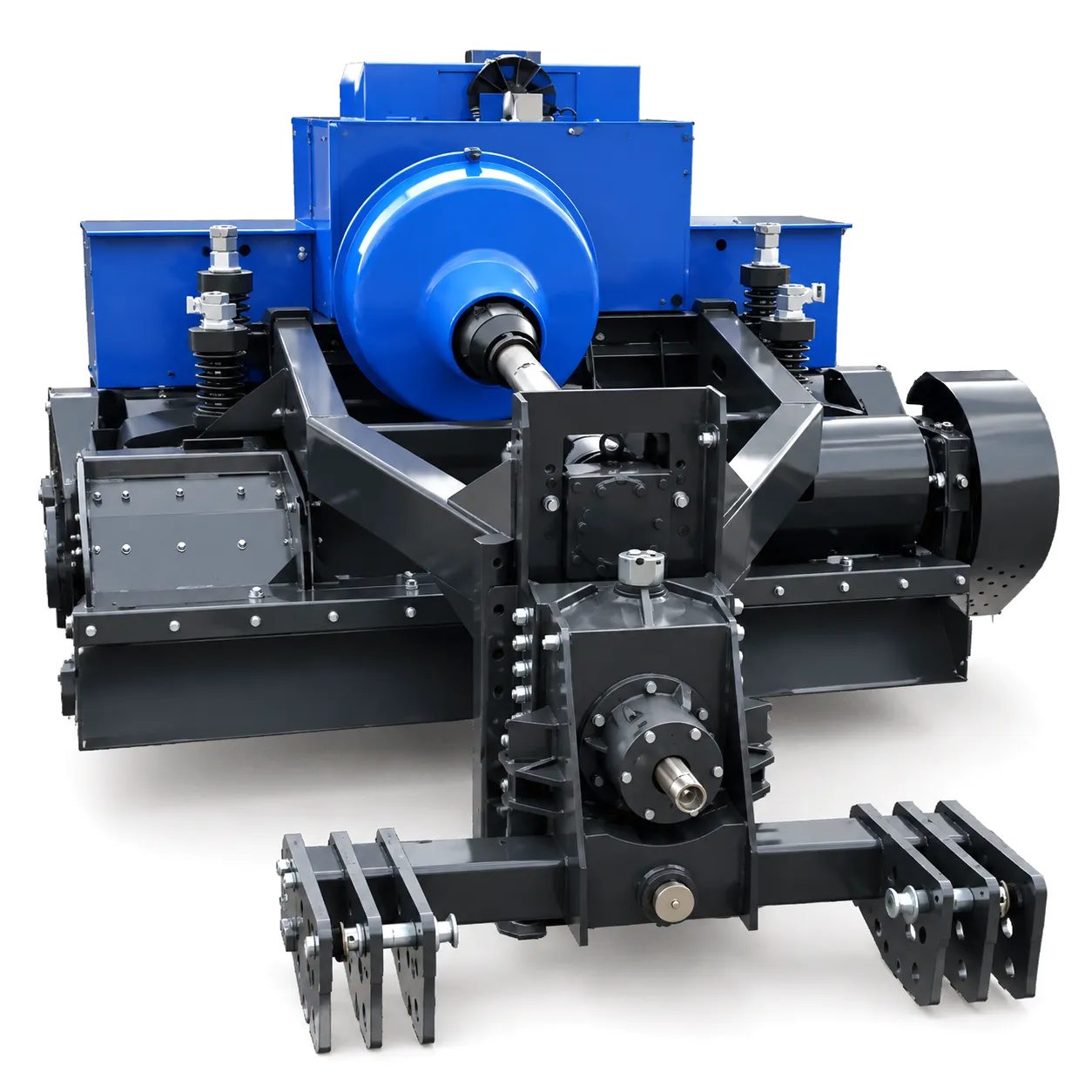
The flywheel — typically a cast-iron or forged-steel component weighing 80 to 150 kg — stores rotational kinetic energy to smooth the load peaks that occur at each plunger compression stroke. This energy buffering is critical on PTO-driven machines because sudden load spikes would otherwise stall smaller tractors or damage gearboxes. The entire driveline — from PTO coupler through gearbox, crankshaft, and connecting rod — must be engineered to tolerances measured in hundredths of a millimetre to sustain the fatigue loads imposed by millions of compression cycles across a machine’s 15-to-25-year working life.
Core Materials in Professional Square Baler Construction
Material selection in a square baler is driven by three competing demands: fatigue strength to withstand cyclic loading, wear resistance at crop-contact surfaces, and corrosion protection in the wet-soil environments common across much of the UK. Cheap baler construction relies on thin-wall mild steel and surface paint as the sole protective measure — a combination that shows its limitations within two or three seasons of heavy work in Yorkshire or Scottish Borders conditions. Premium engineering demands a layered materials strategy.
Frame & Plunger Housing
High-Strength Structural Steel (S355 / Q345B)
Minimum yield strength of 355 MPa. Hot-rolled and robotic MIG-welded sections with full-penetration welds at stress concentration points. Post-weld shot-blasting prepares surfaces for epoxy primer before top-coat application.
Plunger Face & Chamber Liners
Boron-Alloy Wear Steel (Hardox 400–450)
Brinell hardness 370–430 HB. Replaceable liner plates bolted to the inner bale chamber, allowing worn surfaces to be replaced without discarding the chamber body. Drastically reduces long-term ownership cost.
Knotter Assemblies
Case-Hardened Alloy Steel (20CrMnTi / 42CrMo4)
Surface hardness HRC 58–62, core toughness maintained for impact resistance. CNC-machined knotter bills, twine discs, and strippers are interchangeable and matched as dimensioned sets. Critical for consistent knot quality in wet straw or high-moisture silage conditions.
Pickup Tines & Auger Flights
Spring Steel (65Mn) with Zinc Phosphate Treatment
Tensile strength 1,080–1,270 MPa. Spring-back geometry ensures tines flex over stones and re-seat without permanent deformation. Zinc phosphate pre-treatment under polyurethane topcoat provides corrosion protection in heavy-dew dawn baling sessions typical of English summers.
Flywheel
Ductile Cast Iron (GGG-50) or Forged 40Cr Steel
Dynamic balance tested to ISO 1940-1 G6.3 grade. The flywheel’s inertia is sized to limit tractor PTO speed variation to under ±5% during the compression stroke, protecting both the tractor’s transmission and the baler’s own drivetrain from shock loading.
Gearbox Casings
GJL-250 Grey Cast Iron or EN-GJS-500 Nodular Iron
Excellent vibration damping properties. Gear sets are carburised and ground to DIN 3962 Grade 7 accuracy, with sealed-for-life bearing housings and remote lubrication grease points brought to accessible panel locations to reduce service time in the field.
Core Technical Advantages of Modern Square Balers
■
High-Density Compression Consistency
Variable-tension bale density systems allow operators to target precise bale weights — critical for automated handling lines in feed mills and biomass energy plants. Consistent bale geometry reduces void space in trailers by up to 18% compared to hand-adjusted machines.
■
Double-Knotter Redundancy Architecture
Dual independent knotting circuits on each twine lane mean a single knotter failure does not stop baling. The machine continues producing single-knot bales while the operator addresses the fault — preventing crop loss during the narrow summer harvest windows British farms depend on.
■
Integrated Pre-Cutter Blade System
A bank of hardened knife blades positioned at the crop entry throat chops incoming material into shorter lengths before compression. This reduces the bale’s internal friction angle, enabling higher density at lower PTO power, and produces shorter stem segments that improve fermentation uniformity in haylage applications.
■
Sealed Lubrication Manifold System
Centralised grease manifolds with colour-coded nipple blocks reduce daily lubrication time from 35–45 minutes on a conventional machine to under 8 minutes. All critical bearings — plunger, crankshaft, and pickup shaft — are reachable from one side of the machine, an important consideration given field-width constraints common in the smaller hedged fields of the West Midlands and South West England.
■
Wide-Swath Pickup with Stone-Ejector Guard
Pickup widths from 2,000 mm to 2,200 mm handle the wide windrows produced by modern high-output mower-conditioners. An integrated stone-ejection trap at the front of the feed channel deflects small stones downward before they reach the pre-cutter blades or the plunger face — a feature that pays for itself rapidly in the flint-heavy chalk soils of Lincolnshire and the South Downs.
■
PTO Overload Shear-Bolt Protection
A calibrated shear-bolt assembly in the primary driveline protects both the tractor’s transmission and the baler’s crankshaft from shock loads caused by slug ingestion or foreign-object strikes. Replacement bolts are stored in an on-board compartment, and replacement takes under four minutes with the tools supplied with the machine.
Product Technical & Performance Specification Table
| Parametr | 9YF-2200 Series | 9YFS-2.2 Double-Chamber | Specification Standard |
|---|---|---|---|
| Bale Cross-Section | 460 × 360 mm | 460 × 360 mm (dual) | ISO 8210:2018 |
| Bale Length Range | 600–1,200 mm (adjustable) | 600–1,200 mm per chamber | Operator-set |
| Plunger Stroke Rate | 82–100 strokes/min | 82–100 strokes/min | At 540 RPM PTO |
| Required PTO Power | 55–85 kW (75–115 HP) | 75–110 kW (100–150 HP) | 540 RPM PTO |
| Szerokość odbioru | 2,200 mm / 1,900 mm / 1,700 mm | 2,200 mm | Working width |
| Bale Weight (Wheat Straw) | 18–28 kg (standard density) | 20–32 kg per chamber bale | At 15% moisture |
| Throughput Capacity | Up to 80 bales/hr | Up to 140 bales/hr | Dry straw, flat terrain |
| Number of Twine Lanes | 2 lanes / 4 knotters | 4 lanes / 8 knotters | — |
| Knotter Material | 20CrMnTi, HRC 58–62 | 20CrMnTi, HRC 58–62 | Case-hardened alloy |
| Chamber Liner Material | Hardox 400, replaceable | Hardox 450, replaceable | SSAB standard |
| Flywheel Inertia | 120 kg, GGG-50 cast iron | 145 kg, forged 40Cr steel | ISO 1940-1 G6.3 |
| Pre-Cutter Blades | 17 blades (optional 25) | 25 blades (standard) | Individual blade replacement |
| Waga maszyny | 2,800–3,200 kg | 3,600–4,100 kg | Road transport weight |
| Frame Steel Grade | S355JR, robotic MIG weld | S355JR, robotic MIG weld | EN 10025-2 |
| Corrosion Protection | Shot-blast + epoxy primer + PU topcoat | Shot-blast + epoxy primer + PU topcoat | ISO 12944-C3 |
| Hitch Type | Category II / III drawbar | Category II / III drawbar | ASAE S278.6 |
Industrial Application Scenarios for Square Balers in the UK
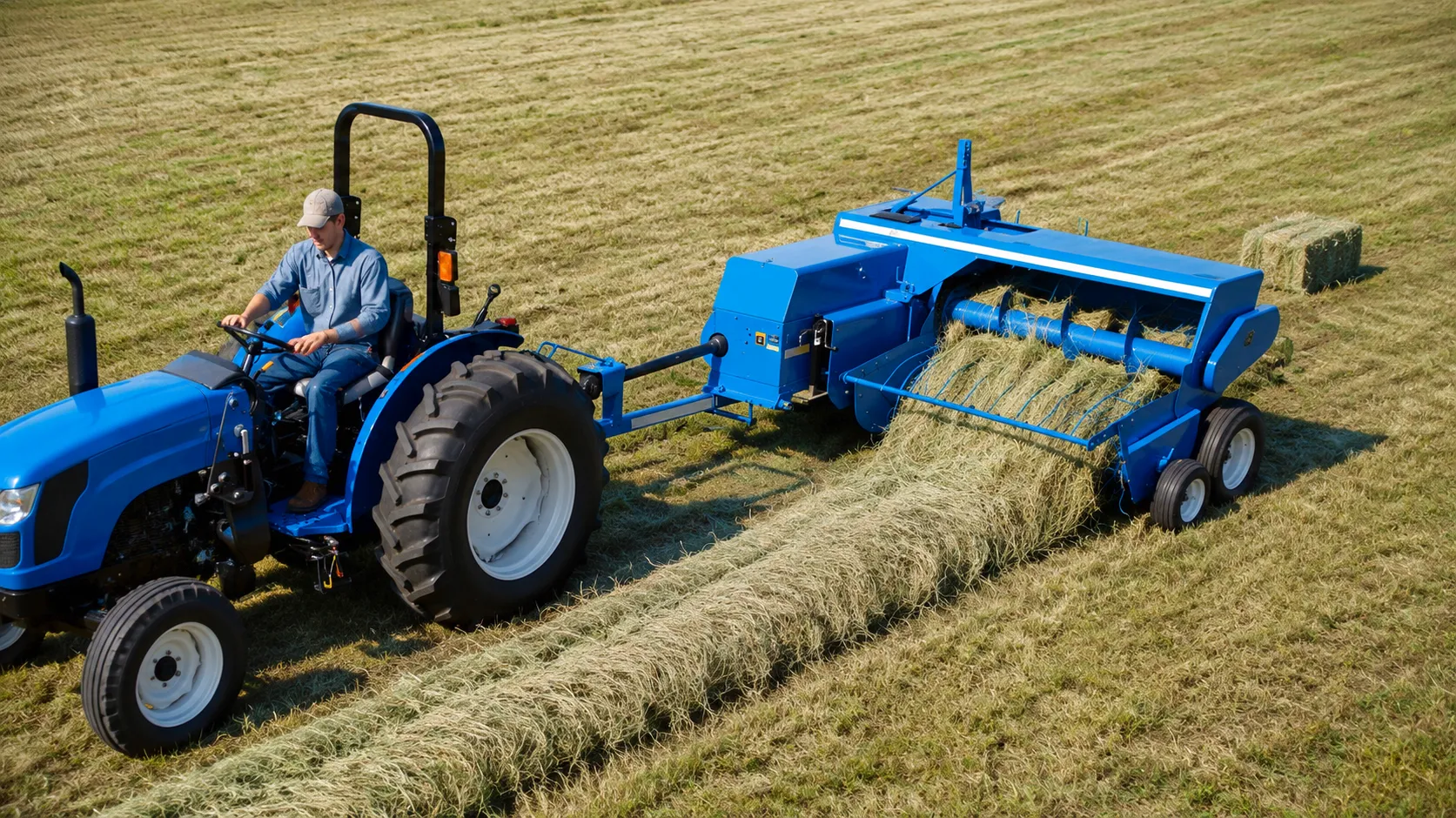
Application: Biomass Energy Supply
Power Station Fuel Baling — Yorkshire, Humber Estuary
Dedicated energy-crop biomass operators in the Humber estuary supply miscanthus and short-rotation coppice to power station fuel handling systems that require bales within tight dimensional tolerances. Square bales — unlike round bales — feed directly into purpose-built shredder lines without additional handling, significantly reducing fuel preparation costs. Throughput demands in this sector regularly reach 1,200 bales per day, requiring reliable high-capacity machines with minimal unplanned downtime.
Application: Equine Bedding & Feed
Premium Straw Baling — Newmarket, Lambourn, Middleham Racing Yards
Thoroughbred racing yards around Newmarket in Suffolk and Lambourn in Berkshire specify tightly compressed, twine-tied square bales because they fit neatly into stable barrow systems and their uniform weight makes stock control straightforward. Dust suppression is critical for respiratory health in horses; the pre-cutter’s short-chop action reduces stem length and slightly increases surface area, which in turn means bales can be shaken out more completely than coarse-cut material. A specialist straw merchant serving this market reported that switching from large round bales to small square bales from an Ever Power machine increased order volume by 35% in the first season.
Application: Straw Board & Fibre Product Manufacturing
Industrial Fibre Baling — Sheffield, Doncaster Manufacturing Corridor
Industrial composite board manufacturers in the Sheffield and Doncaster corridor consume hundreds of tonnes of compressed straw weekly as a raw material for structural panels used in construction. These buyers specify square bales at 300 kg/m³ minimum density, consistent moisture below 15%, and clean twine ties free from metallic contamination. Baling contractors serving this market operate machines around the clock during the late-August to mid-September cereal straw window, placing extreme demands on machine durability and serviceability.
Application: Mushroom Substrate Preparation
Straw Baling for Horticultural Industry — Worcestershire, Herefordshire
Specialist mushroom growing businesses in Worcestershire and Herefordshire purchase wheat straw in small square bale format because their tunnel-pasteurisation substrate production lines are dimensioned to accept this geometry. The uniformly short chop produced by pre-cutter equipped machines pasteurises more evenly than long-stem straw, leading to significantly higher yields per tonne of substrate. Consistent bale weight also simplifies the gravimetric addition of spawn inoculant during mixing.
Ever Power Factory Manufacturing Capability
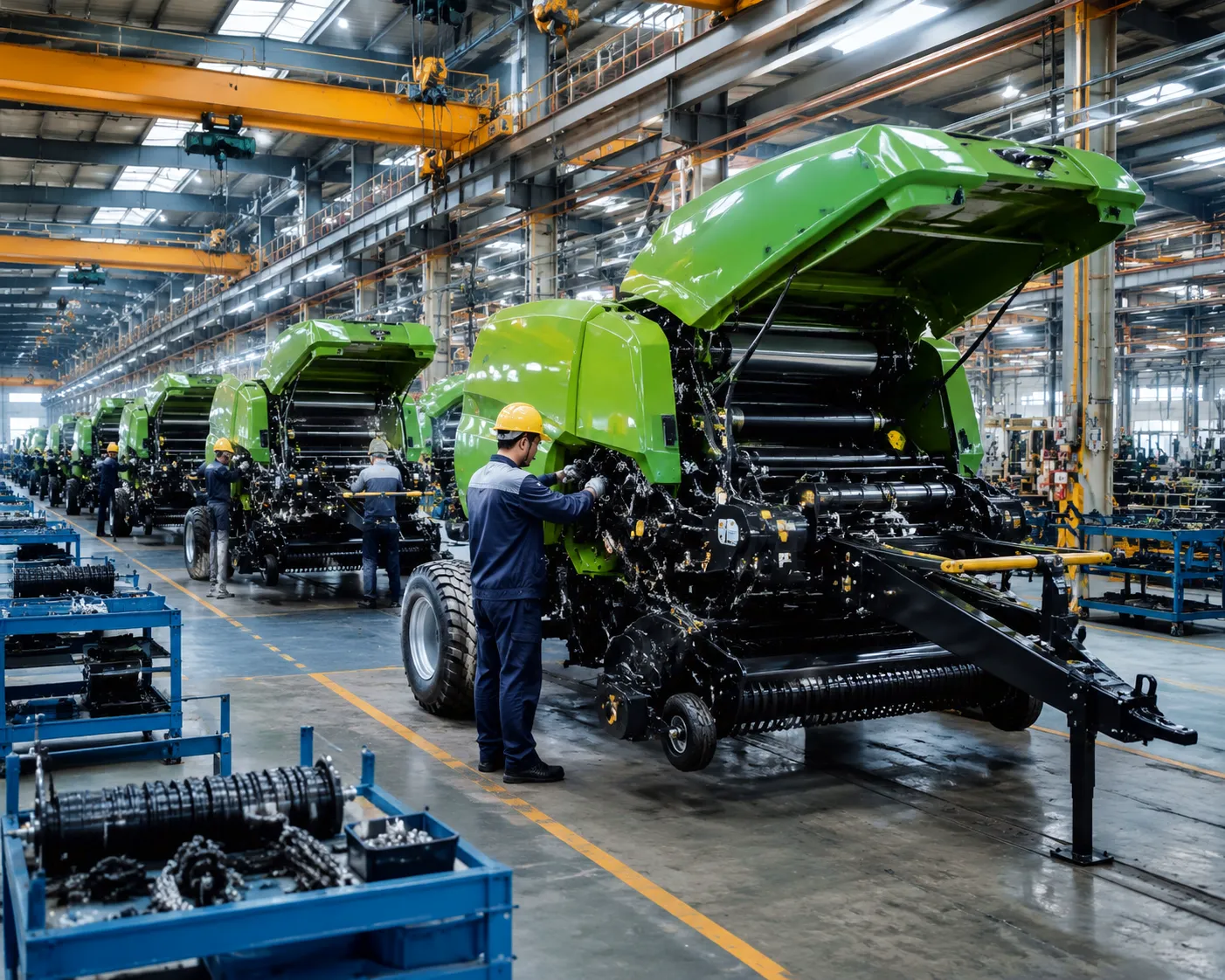
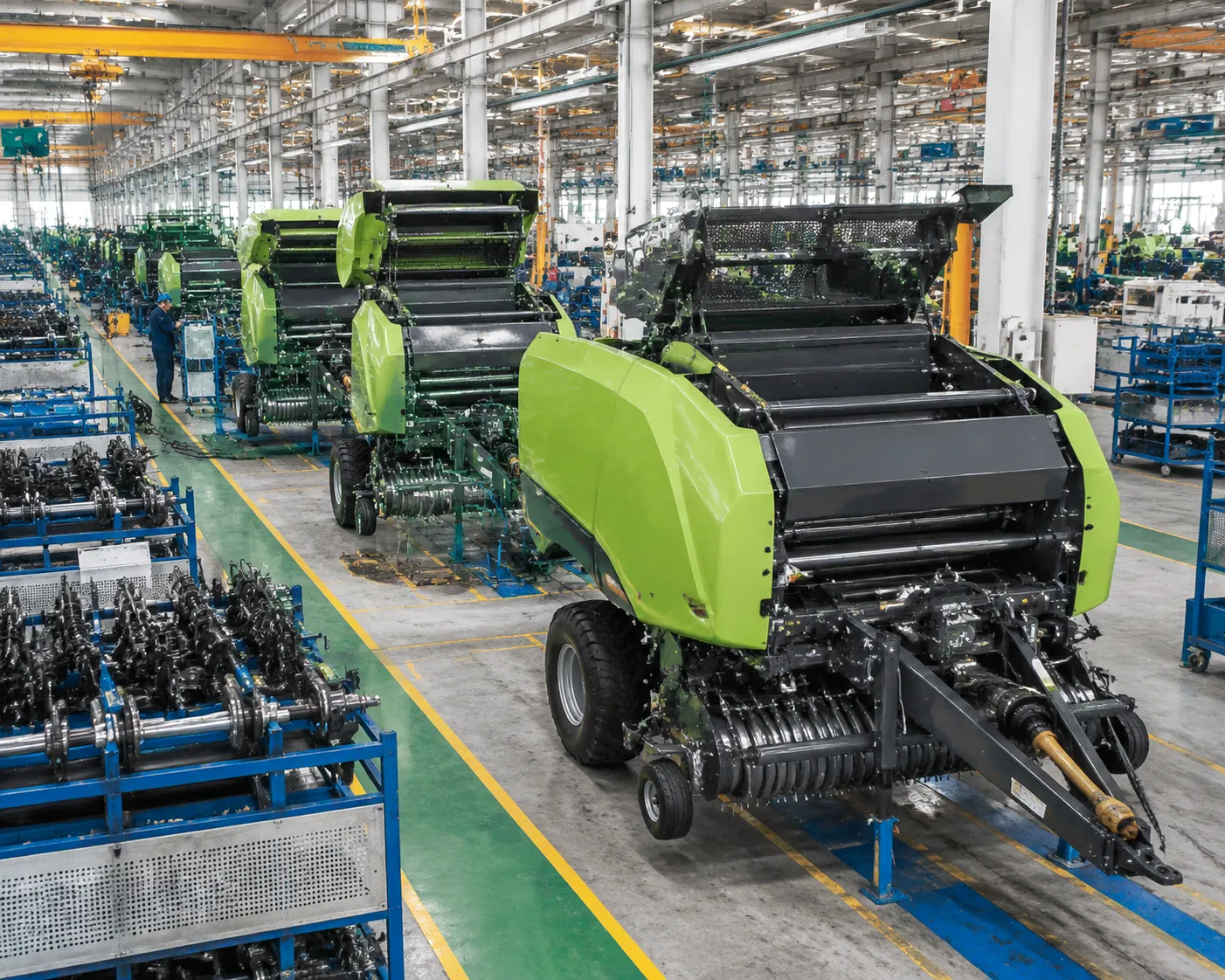
Ever Power operates a dedicated agricultural machinery manufacturing facility covering over 42,000 square metres of production floor space, purpose-built for the engineering complexity that professional-grade square balers demand. The facility combines robotic MIG welding cells — operating to ±0.3 mm positional tolerance — with CNC machining centres handling knotter components, crankshafts, and plunger guide rails. Every major weldment undergoes dimensional verification against 3D CAD models before moving to the painting hall, where an automated shot-blasting and electrostatic epoxy application system produces a corrosion protection rating of C3 under ISO 12944, appropriate for the damp ambient conditions common in UK field operations.
Ever Power’s customisation capability sets it apart from standard catalogue suppliers. The engineering team has developed a structured configuration process that allows buyers — whether individual contractors in Scotland or distribution partners supplying the Midlands agricultural merchant trade — to specify pickup width, pre-cutter blade count, twine lane configuration, and optional electronic bale counters or weighing systems without extending standard lead times beyond 35 working days. Custom colour schemes, dealer livery, and OEM badging are handled in the same production run, eliminating the secondary cost of re-spraying machines at the receiving end.
Supply chain reliability at Ever Power is underpinned by safety-stock agreements with steel suppliers and a component buffer inventory that covers 90 days of production. This means that when demand peaks — as it does every July and August when British farmers begin sourcing machinery for the coming season — Ever Power can confirm delivery slots rather than vague lead times. Spare parts packs tailored to the UK market, including metric-specification fasteners, compatible twine tensioner springs, and knotter replacement kits with British English documentation, ship with every machine as standard.
Featured Ever Power Square Baler Models
Customer Success Story: Doncaster Biomass Contractor, South Yorkshire
Across the 2024 harvest season, the three machines produced a combined total of 47,200 bales across wheat straw, barley straw, and miscanthus. Recorded unplanned downtime across all three machines totalled 4.5 hours — attributable entirely to a twine supply issue unrelated to machine function — against an industry benchmark figure of 12–18 hours for comparable fleet hours. Bale weight consistency on the 9YFS double-chamber unit, measured by the biomass buyer’s weighbridge at point of delivery, showed a standard deviation of ±0.7 kg against the 29.5 kg target weight — comfortably within the ±1.5 kg contract specification. The biomass buyer subsequently offered Bridlewood a three-year supply agreement, citing the improved bale quality consistency as a key factor.
“We were sceptical about switching from a European brand we’d used for years, but the Ever Power 9YF-2200 has proved itself across a very demanding season. The knotter reliability on wet barley straw — which kills knotters on cheaper machines — was genuinely impressive. We had zero missed knots in 22,000 bales on the first machine.”
James Holbrook — Owner, Bridlewood Agricultural Contracting, Doncaster
“The double-chamber baler’s output transformed what we could deliver in a single shift. We were completing fields we’d previously needed two passes and two machines to clear. The Ever Power engineering team’s responsiveness when we had configuration queries pre-delivery was better than anything we’d experienced with established brands.”
Sarah Holbrook — Operations Manager, Bridlewood Agricultural Contracting, Doncaster
“From a biomass buyer’s perspective, bale weight consistency is everything — it affects trailer loading efficiency, payment calculations, and furnace feed rate. The Ever Power-baled material we received in 2024 showed the tightest weight distribution we have seen from any contractor supplier. We have offered a long-term supply agreement on the strength of it.”
Mark Whitfield — Supply Chain Manager, Humber Biomass Energy Partners Ltd, Hull
Frequently Asked Questions — Square Balers for UK Agricultural Operations
What is the typical cost or price of a professional square baler for a UK farming operation, and how do I get a quote from a reliable supplier?
Professional-grade square balers for UK farming range broadly from approximately £18,000 to £65,000 depending on configuration, pickup width, pre-cutter specification, and output capacity. Single-chamber models at the lower end of the range suit contractors operating up to 1,500 acres per season, while high-output double-chamber machines represent the upper end. Ever Power offers transparent pricing with no hidden freight markups for UK buyers; you can receive a detailed, itemised quote within 48 hours by contacting [email protected] with your acreage, crop type, and preferred pickup width.
Which square baler model should I choose if I am baling wheat straw in Lincolnshire and need to produce more than 100 bales per hour during harvest?
For throughput exceeding 100 bales per hour in Lincolnshire cereal straw conditions, the 9YFS-2.2 Double-Chamber Square Baler from Ever Power is the appropriate choice. Its dual independent bale chambers produce up to 140 bales per hour from a single tractor pass, and the standard 25-blade pre-cutter handles the long-stem wheat straw typical of Lincolnshire and Cambridgeshire harvests without slug blockages. You will need a tractor supplying a minimum of 100 kW (135 HP) at the PTO shaft to maintain consistent plunger stroke rate at full output.
How often do the knotters on a commercial square baler need to be serviced or replaced, and what does that cost from a UK spare parts supplier?
On a well-maintained professional square baler, knotter assemblies should be inspected every 5,000 to 8,000 bales and fully overhauled or replaced at 20,000 to 30,000 bales depending on crop conditions and twine quality. Running with abrasive dusty straw or poor-quality twine accelerates wear on twine discs and bill hook tips. Ever Power supplies matched knotter overhaul kits for all their models with full UK-standard documentation, and the component cost for a full four-knotter overhaul kit typically falls in the £280 to £480 range depending on specification.
Where can I find a reputable square baler supplier in the UK who offers flexible delivery times and genuine post-sales technical support for farming operations in Scotland?
Ever Power ships directly to UK agricultural buyers including Scottish farms and machinery dealers, with delivery to a Scottish destination typically taking 18 to 28 days from confirmed order. Post-sales technical support is provided via a dedicated English-language support channel with same-day response during the UK growing season from April through October. Spare parts packs designed specifically for Scottish operating conditions — including additional anti-corrosion treatments for exposed coastal locations — can be included at the point of order.
What is the minimum tractor horsepower needed to run an Ever Power 9YF-2200 Square Baler efficiently on heavy, damp grass silage crops in the Yorkshire Dales?
The 9YF-2200 is rated for tractors delivering 55–85 kW (75–115 HP) at the PTO. For damp grass silage in the Yorkshire Dales — where crop moisture can remain above 30% even after wilting — the upper end of this range, around 90–100 HP, is advisable. High-moisture grass generates significantly higher compression resistance than dry cereal straw, and a well-matched tractor ensures consistent plunger stroke rate is maintained without the speed-hunting that leads to inconsistent bale density and increased knotter stress.
How does a double-chamber square baler differ from a standard single-chamber machine in terms of price, output capacity, and maintenance requirements for a large arable farm in East Anglia?
A double-chamber square baler like the Ever Power 9YFS-2.2 typically costs 55–70% more to purchase than a comparable single-chamber model, but delivers nearly double the bale output per hour from the same tractor. For a large East Anglian farm covering 3,000 or more acres of cereal crops, the additional capital cost is generally recovered within two to three seasons through reduced labour hours and the ability to clear fields within tight weather windows. Maintenance requirements are proportionally greater — twice the knotters, twice the pre-cutter blades — but both chambers share a common driveline and pickup assembly, so service access and parts commonality reduce complexity considerably.
When is the best time of year to order a square baler for delivery before the UK harvest season, and how long does shipping from an overseas manufacturer typically take?
For UK harvest readiness, placing an order by early April gives comfortable margin for a June delivery before the July–August peak season. Ever Power’s standard production and shipping lead time to the UK is 25–35 working days from order confirmation, covering both manufacturing lead time and sea freight transit. Buyers who need a machine for a specific date — such as an early silage cut in late May — should aim to place an order no later than late February and confirm their exact specification, including any custom options, at the point of order.
Ever Power Industrial — Square Baler Specialists
Ready to Upgrade Your Baling Operation?
Contact the Ever Power team for a detailed technical consultation, custom configuration quote, or to request our UK-market spare parts guide.
Uzyskaj wycenę — [email protected]
edytuj przez gzl